
Belgium
Implementing the 2030 Agenda: Will Belgium Step Up Its Efforts?
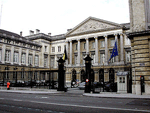
In September 2015, Belgium declared that the 2030 Agenda will give a new élan for Belgian global engagement, calling for human rights, LGBT rights, women's rights, decent work and the power of digitalization, concluding that Belgium was ready to implement the agenda. However, by referring mainly to international cooperation, it was not clear if Belgium accepted the challenge to also change its national policy in order to reach the 2030 Agenda. A national strategy framework is to be established by September 2016 involving all levels of government, under the auspices of the Inter-Ministerial Conference for Sustainable Development (IMCSD), which is best suited to ensure a coherent strategy among the three regions and the federal government. Nevertheless, midway into the first year of implementation, the policy actions needed remain distant. Belgium should have had a head start, since a 1997 law on the coordination of the federal policy on sustainable development authorizes the federal government to set out a plan that takes into account the long-term vision of sustainable development and international commitments taken to realize it. The SDGs are the result of a political negotiation and are not always as ambitious as needed. Yet the achievement of these goals would be a crucial step forward. It is important that Belgium meet the challenges of this universal 2030 Agenda through an integrated, overarching strategy.
Published on Sat, 2016-07-30 12:23
In September 2015, Belgium declared that the 2030 Agenda will give a new élan for Belgian global engagement, calling for human rights, LGBT rights, women's rights, decent work and the power of digitalization, concluding that Belgium was ready to implement the agenda. However, by referring mainly to international cooperation, it was not clear if Belgium accepted the challenge to also change its national policy in order to reach the 2030 Agenda. A national strategy framework is to be established by September 2016 involving all levels of government, under the auspices of the Inter-Ministerial Conference for Sustainable Development, which is best suited to ensure a coherent strategy among the three regions and the federal government. Nevertheless, midway into the first year of implementation, the policy actions needed remain distant. Belgian civil society organizations demand and urgent and clear response to the challenges of this ambitious universal 2030 Agenda, and to commit to develop an integrated, overarching strategy covering internal and external affairs. |
Published on Mon, 2015-10-05 12:33
With a "Fiesta Social" combining music, films and speeches, some twenty Belgian civil society organizations launched last October 3 a major campaign titled "Social protection for all" with the aim of defending social security as a human right in Belgium and abroad. |

Published on Fri, 2012-12-07 12:58
“International cooperation is in danger. In Europe, which is still the biggest donor in the world, official development assistance fell for the first time since 2007, and Belgium is not an exception. In times of crisis the tendency is for fiscal austerity”. This is the conclusion of the National Cooperation Centre for Development (CNCD-11.11.11) in its contribution to the Social Watch Report 2013. |
|
Published on Mon, 2012-03-19 08:36
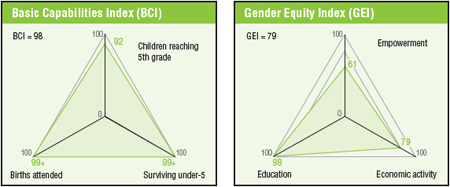
In terms of gender equity Belgium places itself above the European average, and its only neighbour in a better situation is Germany. |
Published on Tue, 2011-05-24 07:23
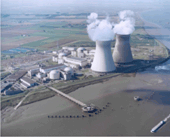
Source: CNCD-11.11.11 Twenty-five years after the Chernobyl disaster, and when another tragedy is going on in Japan, the Belgian chapter of Greenpeace International, WWF, the Walloon Inter-Environmental Federation and Bond Beter Leefmilieu (BBL) launched the national platform "Stop & Go" that calls for the end of nuclear energy generation and claims for promoting renewable sources. |
|
Source:
|

|
Source:
|

|
Source:
|

SUSCRIBE TO OUR NEWSLETTER
 |
