Bangladesh
SDG Progress in Bangladesh: Competencies or Complacence?
Published on Sat, 2020-10-10 00:00
Join the Conference and empower BDCSOprocess virtual annual conference 2020
“Toward A Self Esteemed Independent CSO/NGO Sector”
In Zoom with Bangla and English translation facilities. Non-member, please register in this link, you will receive the software link later.
Session 10th Oct. Dhaka time 11h30: UN in 75, Interfacing Government and Civil Societies for Development and Sustainable Peace
|
Published on Wed, 2019-10-23 14:40
Inequality is a major concern for civil society in Bangladesh. The report by the Equity and Justice Working Group Bangladesh (EquityBD) quantifies rising inequalities. The Palma ratio (between the income of the richest 10% and that of the poorest 40%) grew from 1.68 in 1964 to 2.93 in 2016. Inequalities are addressed in the official plans but EquityBD considers that implementing them “will be a tough job for the Bangladesh government due to lack of good governance in some cases. The financial sector is still in a need of special attention since illicit financiale flows and huge amounts of non- performing bank loans are still in force. Decentralization of development is another crucial issue.”
|
Published on Sun, 2018-08-26 00:00
The UN Committee for Development Policy has announced Bangladesh’s eligibility for graduation from Least Developed Country to Developing Country. This success also brings confidence for achieving the SDGs. In the last 15 years, with limited resources, Bangladesh has witnessed one of the fastest reductions in poverty anywhere in the world. The country has met the target in reducing the proportion of population below the national poverty line (currently 22.4%) three years ahead of time. It has reached the targets in reducing infant mortality rate from 92 per 1000 live births in 1990 to 46 now; and in decreasing the prevalence of underweight children less than five years of age from 66 percent in 1990 to 32.6 percent at present. In terms of education, the country has achieved nearly 100 percent enrollment in primary schools; and attained gender parity with more girls than boys in primary and secondary schools.
|
Published on Mon, 2017-10-09 12:45
The government of Bangladesh has announced an inclusive approach to development so that the poorest and the most vulnerable populations can be integrated into its national development efforts. This "whole society approach" requires the engagement of all stakeholders in the process. Civil society organizations envisage a strengthening of democratic institutions and participatory governance to achieve the SDGs in Bangladesh, with participation of civil society in all levels of implementation, from the national to the grassroots level.
They therefore demand that "IFIs and the WTO must respect policy spaces for LDCs and developing countries so that national sovereignty in decision-making and the very nature of the State in respect to welfare and redistributive justice can be protected".
|
Published on Fri, 2016-06-10 15:11
Since the 1990s, when democracy was reinstated, Bangladesh has been able to make some extraordinary achievements. The poverty rate was 57 percent in 1991 and was reduced to 31.5 percent in 2010, enrolment in primary education reached 98 per cent and girls slightly outnumber boys in schools. But budget allocations to health and social security are far from enough, corruption and illicit financial flows divert resources and climate change is set to produce more physical damage in Bangladesh by 2025 than in any other country. Rising sea levels, severe storms and other extreme climate-related events are going to produce millions of "climate refugees" in a country that has not contributed to generate this phenomenon and is not receiving compensation for enormous loss and damages.
|
Published on Thu, 2014-04-03 17:37
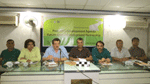
Photo: equitybd.
|
In a panel discussion held in Dhaka Reporters’ Unity Mr. Roberto Bissio, the Coordinator of Social Watch, a global civil society alliance working in more than hundred countries, said that the enforcement for human rights and addressing inequalities should be the main concern in setting post 2015 development agenda.
The panel discussion titled “Post 2015 Development Agenda: Future Global Development Partnership” organized by EquityBD, Social Watch Bangladesh and Unnayan Samunnay. The panel discussion is moderated by Rezaul Karim Chowdhury of EquityBD and other speakers of the session are Ahmed Swapan of VOICE, Aminur Rasul of Unnayan Dhara Trust, Prodip K Roy of Online Knowledge Society, Dr Sohel Iqbal, Badrul Alam of Bangladesh Krishok Federation (BKF) and Barkat Ullah Maruf of EquityBD.
|
Published on Thu, 2013-11-07 14:25
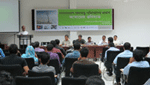
Photo. EquityBD.
|
Right based civil society networks in cooperation with different students’ cultural organizations of Dhaka University organize a seminar at the Nowab Ali Chowdhury Senate Building and a photo exhibition at the Teacher Student Centre (TSC) in Dhaka University. The vice chancellor of the university Mr. A A M S Arefin Siddique inaugurates the photo exhibition.
|
Published on Tue, 2013-06-04 21:04
Speakers demanded debt
cancellation and democratic space
for LDCs. (Photo: SW Bangladesh).
|
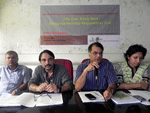
[Dhaka, Tuesday, 4 June 2013] Civil society right groups network EquityBD and VOICE in a press conference held at the city’s national press club criticized United Nation High Level Panel (UN HLP) report on post 2015 agenda terming it “as lofty goal and empty bowl” and said that the report is in fact a far short in transforming economies. The UN HLP report has just published on 30th June 2013 in New York. The UN HLP was co chaired by UK Prime minister Davide Cameron, Indonesian President Dr. Susilo Bambang and Liberian President Alen Johnson Sirlef. Moderated by Rezaul Karim Chowdhury, chief coordinator of Equitybd, the position paper was read out by Ahmed Swapan Mahmud, executive director of Voice.
|
Published on Thu, 2012-11-29 09:29
Dhaka, capital city of
Bangladesh, under the water in
2004. (Photo: EquityBD)
|
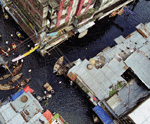
The international community must rule out the “one size fits all” approach and design an “effective sets of goals” needed to ensure a sustainable development, letting the solutions to be defined by each country, recommends the Social Watch coalition in Bangladesh, a nation severely affected by climate change. The new framework must ensure “equity”, “justice”, “the preservation of Mother Earth and the life and livelihood of all human beings,” adds the Bangladeshi contribution to the Social Watch Report 2013.
|
Published on Mon, 2012-11-19 07:48
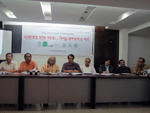
Photo: EquityBD
|
The Bangladeshi Civil Society Climate Network urged the government representatives to emphasize on equity and justice and to uphold climate vulnerable country interest at the 18th session of the Conference of the Parties (COP-18) scheduled to begin November 26 in Doha.
|
Published on Thu, 2012-10-25 10:39
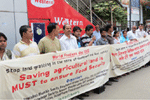
(Photo: EquityBD)
|
Seventeen civil society organization headed by EquityBD along with the South Asia Alliance for Poverty Eradication (SAAPE) carried out a human chain in Dhaka observing 16th October as World Food Less Day, the same date the United Nations proclaims as the World Food Day, to raise the voice on behalf the hungry people.
|
Published on Thu, 2012-05-31 19:48
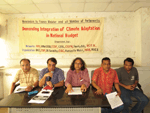
Photo: EquityBD
|
Fifteen Bangladeshi civil society organizations urged the government to integrate climate adaptation measures in the national budget and to give thrust on self finance or local resource mobilization. In a press conference, the groups warned that it would be unwise to expect or depend on foreign aid in this regard.
|
Published on Mon, 2012-05-07 09:50

Waiting for gas in Dhaka,
Bangladesh. (Photo: Georges
Gobet/Newscom/IMF website)
|
The International Monetary Fund (IMF) approved a loan of one billion dollars to Bangladesh after two years of negotiation. The Equity and Justice Working Group (EquityBD), an alliance of right-based civil society organizations, has continuously and consistently protested it. This is the first loan that the Asian country has taken in seven years.
|
Published on Tue, 2012-04-17 08:31
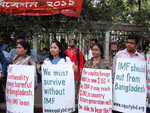
Protest against the IMF in Dhaka
|
Equity and Justice Working Group (EquityBD), a Bangladeshi alliance of rights-based civil society organizations, urges the government in Dhaka to open public and parliamentary debates in case of receive foreign loans in the name of assistance and development. The statement issued by the coalition in its regard refers to a 987 million dollars loan approved last week by the International Monetary Fund (IMF).
|
Published on Thu, 2012-03-15 11:48
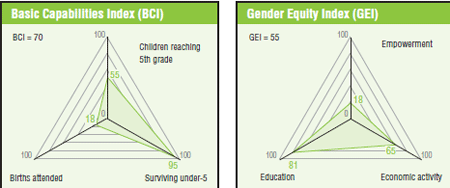
In terms of gender equity Bangladesh is in far better position than its neighbour India, and above the South Asian average.
|
Published on Wed, 2012-03-14 09:28
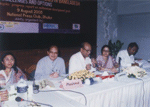
Atiur Rahman (Social Watch),
Manzoor Ahmed (Education Watch),
Rasheda K Choudhury (Peoples'
Forum on MDG), and Arifur Rahman
(Manusher Jonno).
(Photo: The Daily Star)
|
The centralization in Dhaka, the capital city of Bangladesh, is responsible for the unsustainable development of that South Asian country, according to the Social Watch Report 2012. The historical absence of long-term planning and overpopulation are the main cause of environmental degradation and resource depletion, said Rezaul Karim Chowdhury, executive director of Coastal Association for Social Transformation (COAST Trust) while launching the study.
The report, based on 670 reports of 66 nations, said in its Bangladesh part that centralisation has accentuated geographical imbalance in income in the country.
|
Published on Wed, 2011-10-26 12:18
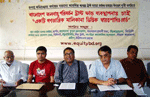
Photo: EquityBD
|
Bangladeshi civil society organizations demanded participation in the management of the official climate change funds for their representatives and those of the affected communities, to enhance their transparency and accountability. The claim was made at a national consultation in Dhaka, moderated by Equity and Justice Working Group (EquityBD), an alliance of several institutions and renowned citizens.
|
Published on Tue, 2011-10-04 08:33
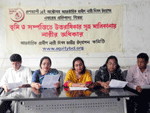
National Committee press conference.
(Photo: EquityBD)
|
The Government of Bangladesh must take steps to ensure women’s equal rights to land and inheritance, urged civil society organizations. "Men and women have to fight together to establish women's right," said M Rezaul Karim Chowdhury, member of Equity and Justice Working Group (EquityBD), an alliance of several Bangladeshi groups and individuals.
|
Published on Fri, 2011-06-17 09:34
Sources
The Daily Star (Dhaka)
The New Nation
A budgetary plan to cut farm subsidies will frustrate farmers and the sector as a whole, as they still need special care for a few more years, warned this week Khondar Ibrahim Khaled, emeritus fellow of Unnayan Shamannay (national focal point of Social Watch).
|
Published on Wed, 2010-02-17 16:22
Call on the eve of Bangladesh Development Forum meeting
Dhaka, 15th February 2010. Twenty one civil society organizations (CSO), in a rally and human chain in front of national press club, called upon the developed country representatives and donors, who are participating in Bangladesh Development Forum (BDF), to pay their carbon debt as compensation.
|
|
Source: 
. Published on Thu, 2009-03-19 15:28
|
|
Source: 
. Published on Wed, 2005-08-10 11:11
|
SUSCRIBE TO OUR NEWSLETTER
Submit
|