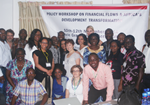
Ghana
Ghana's socio-economic transformation and the imperative for equitable and inclusive development Current debates in Ghana about sustainable development express a confluence of four important trends: 1) questioning of the growing inequalities and exclusion wrought by the dominant neoliberal economic policies and the quality of growth that has resulted; 2) recognition of the advances that the 2030 Agenda for Sustainable Development and its 17 Sustainable Goals (SDGs) represent on the minimal ambitions of the Millennium Development Goals (MDGs); 3) African recognition of the limits of raw material commodity export dependence and the need for structural economic transformation; and 4) the rediscovery of development planning as an important tool and policy framework.
Published on Fri, 2019-06-14 09:41
"As of 2019, women’s representation in Parliament remains at an abysmal 13.7% and women constitute only 18.55% of all ministerial appointments. For the first time since its creation, the Gender Ministry no longer has cabinet status. Sexual and gender-based violence remains a big problem, notwithstanding the existence of the Domestic Violence Act, and budgetary allocations for effective implementation of the law is low." This is one of the conclusions about gender disparities in Ghana, as diagnosed by NETRIGHT, a network of about 100 civil society organizations and over 300 individuals. Netright believes that "the conditions of marginalized or disadvantaged groups, including women, can never be improved solely through their own efforts, no matter how dynamic they might be, since systemic barriers and structures of male privilege and dominance maintain the status quo."
|
Published on Mon, 2019-05-27 17:42
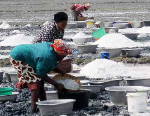
Ghana has the best endowment for and is the biggest producer of solar salt in West Africa. The bulk of the production and export comes from artisanal and small scale (ASM) producers. Third World Network Africa (TWN-Af) presents a research report "Towards Optimal Expoitation of Salt from the Keta Lagoon Basin in Ghana" based on struggles between a large scale salt company and some communities around the Keta Lagoon in Ghana. At the centre of the conflict is the disruption of the livelihoods of the communities by the award of a concession to a foreign investor for large scale salt production, an act which has expropriated what the communities see as the commons around the lagoon where for generations they have carried out livelihood activities which combine fishing, farming and salt production.
|
Published on Wed, 2017-08-02 10:16
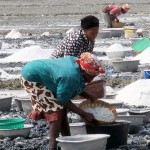
Women salt winners at work
|
For the third time in 10 years the government of Ghana is involved in a drive to stop illegal artisanal and small scale gold mining, popularly called 'galamsey'. Unlike the previous times the state is supporting rather than leading the campaign against 'galamsey'.
There is currently a campaign spearheaded by the media against the activities of illegal gold mining in Ghana. This campaign has not only called for all unsanctioned and unregulated small- scale gold mining activities to be brought to a halt, but has also led to calls for the operations of legalized small-scale gold miners to be stopped as well. Ghana's policy makers have taken up the cause and have taken a series of actions aimed in the short term, at addressing the challenges posed by illegal small-scale gold mining, 'galamsey'.
|
Published on Thu, 2017-06-15 22:50
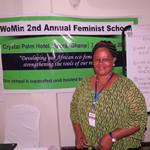
Sarah Makau, Kenya
|
"What we have to ask ourselves is this: is Africa in control of our resources or is Africa entangled in this global system of accumulation which was brought by colonialism? How do we escape that bondage?" summarized Mela Chiponda, a participant at the Second annual WoMin Feminist School, hosted by Netright Ghana.
"We didn't have title deeds, the land was not demarcated, nobody knew the acreage of their farms. So when we learned about this, the government came in and started to demarcate. and there was pause in the mining activities. But we are worried. It feels like a lion we have chased off, and it's lying in the grass waiting" said Sarah Makau, from Kenya.
|
Published on Fri, 2017-02-03 09:20
TUDCN has undertaken three national case studies in Ghana, Indonesia and Uruguay to analyse social dialogue within the countries in its various forms, with particular focus on the formalisation of these dialogues at different administrative levels and its contribution to development. The studies are authored by national trade union specialists and include examples of good practice as well as of limitations of the different contexts.
|
Published on Fri, 2016-10-14 19:41
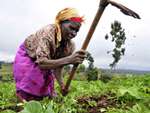
Photo: African Agenda.
|
Current debates in Ghana about sustainable development express a confluence of four important trends: 1) questioning of the growing inequalities and exclusion wrought by the dominant neoliberal economic policies and the quality of growth that has resulted; 2) recognition of the advances that the 2030 Agenda for Sustainable Development and its 17 Sustainable Goals (SDGs) represent on the minimal ambitions of the Millennium Development Goals (MDGs); 3) African recognition of the limits of raw material commodity export dependence and the need for structural economic transformation; and 4) the rediscovery of development planning as an important tool and policy framework.
|
Published on Thu, 2016-02-04 15:57
Much will depend on the capacity and determination of civil society to leverage the necessary political will opines.
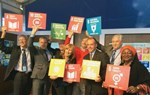
A rare sense of euphoria permeated the adoption of the 2030 Agenda and the Sustainable Development Goals (SDGs) in New York. The multitude of events that have been taking place on First Avenue and beyond had a party atmosphere. And it was not only government delegates but many civil society activists who negotiated for systemic change that celebrated the new agenda that promises transformative change for sustainable development. Yet will implementation actually bring real change?
|
Published on Fri, 2015-06-26 14:59
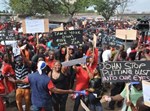
The country is experiencing its worst energy crisis in over a decade which is paralysing the economy and ruining livelihoods. Two public demonstrations were held late February in Accra and Kumasi, Ghana's two main cities, over electricity load-shedding which gives consumers 12 hours electricity and 24 hours total blackout.
But while the opposition-led demonstrators were thumping the streets with anti-government placards and slogans, organised labour in the country took up the struggle on a different front largely ignored by organisers of the demonstration but which many consider as being at the heart of the energy crisis.
|
Published on Thu, 2015-05-07 09:30
Contrary to the prevailing image, Africa is a net exporter of capital. The United Nations Economic estimates the net financial outflow between the years 1970 and 2008 at around 800 billion US dollars. This is much more than all the official development assistance received by the continent. And the illicit financial outflows from Africa have accelerated exponentially during the last decade.
This is the conclusion of a high level panel on illicit financial flows that was set up by the African Union. The panel was chaired by former South African president Thabo Mbeki and it was launched in January. Yao Graham, coordinator of TWN-Africa argues that the illicit financial flows are only the tip of the iceberg and a manifestation of an economic system that privileges foreign capital and corporations to the neglect of the interests of majority of Africans and domestic capital.
|
Published on Mon, 2013-09-30 19:19
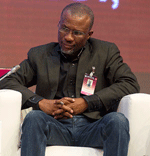
Tetteh Hormeku
|
Third World Network-Africa (TWN Africa) has punched holes into the revised Ghana Investments Promotion Centre (GIPC) Bill, noting that there has been little change to the provisions.
According to the non-governmental organization, the changes in the provisions did not offer any relief for domestic producers.
|
Published on Thu, 2013-08-15 21:56
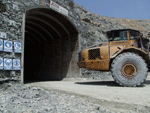
Ahafo Mine at Kenyasi, in
Asutifi District. (Photo:
Ghana’s Mining Portal)
|
The commodity dependence of most African countries has intensified, despite claims of remarkable economic performance in recent times, Dr Yao Graham, Coordinator of the Third World Network Africa, has said.
Addressing participants at the 14th Review and Strategy Conference of African Initiative on Mining Environment and Society (AIMES), Dr Graham said amidst the deafening rhetoric that Africa is rising; most countries on the continent continue to reel under unfavourable economic conditions.
“The economies of most countries on the continent are fragile and this is going side by side with the deafening rhetoric that Africa was rising,” he said, at the opening session of the conference.
|
Published on Fri, 2012-12-14 08:38
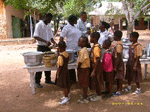
School lunch in Ghana
(Photo: Ndcuk.org)
|
The lack of political will seems to be the main obstacle on Ghana’s road to development and human well-being, but it is not the only one, according to the contribution from civil society organizations of this West African nation to the Social Watch Report 2013.
Ghana has walked a long way towards poverty eradication, food security and education to all, but not all the people have access to medical services, and not all pregnant woman benefit from free health care, so maternal mortality remains very high, aggravating the endemic gender inequities. With this social landscape as a backdrop, the economy experiences a sustained growth, notes the report.
|
Published on Tue, 2012-08-28 15:00
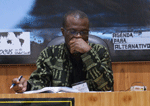
Tetteh Hormeku of TWN-A.
(Photo: Transnational
Institute/Flickr/CC)
|
The Economic Justice Network (EJN), a Ghanaian coalition of civil society organizations working for socio-economic justice and equitable national development, was re-launched to deal with new policy threats affecting livelihoods, reported Ghana News Agency and AllAfrica news portal.
|
Published on Wed, 2012-08-01 08:37
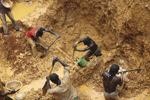
Small-scale gold miners in
Obuasi, Ghana. (Photo: George
Osodi/ Africa Renewal/Panos)
|
Obuasi, about 200 kilometres northwest of Accra, Ghana’s capital, is home to one of the richest gold mines in the whole world. For more than a hundred years the precious metal mined there has been taken to jewellers in the West and beyond, earning millions of dollars for mining companies and their shareholders, wrote journalist Efan Dovi Africa Renewal magazine, published by the United Nations.
|
Published on Fri, 2012-03-16 10:13
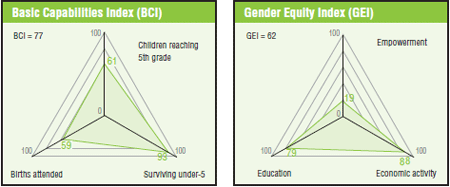
In terms of gender equity Ghana places itself above the Sub-Saharan African average, and also in a better condition than its three neighbours.
|
Published on Mon, 2012-02-20 10:05
|
Ahafo Mine at Kenyasi, in Asutifi
District.
(Photo: Ghana’s Mining Portal)
|
Three months after the announcement of an increase in corporate tax for mining companies from 25 to 35 percent in Ghana, the raise is yet to be implemented. The tax may not be collected until 2013, according to TV3 television channel. “The attitude of government gives reasons to believe that it will yield to pressures from the industry,” wrote Alhassan Atta-Quayson, expert of Third World Network-Africa (TWN-A).
|
Published on Fri, 2011-09-09 10:19
Source: Ghana Nation
A two-day African Regional Capacity Building Workshop for members of Social Watch Coalitions on the continent was held in Accra this week, with the aim to strengthen the capacity of members to actively monitor the implementation of social policies and programmes by their governments.
|
Published on Fri, 2011-09-02 07:24
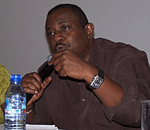
Gyekye Tanoh, of TWN-A, at the
forum. (Photo: MyJoyOnline)
|
Sources: BusinessGhana, ThinkGhana, Ghana Business News, MyJoyOnline, GhanaWeb, AllAfrica
Several Ghanaian civil society organizations warned that the renewal of the interim Economic Partnership Agreement (EPA) between the country and the European Union (EU) will condemn the Western Africa integration process and the national economy to an irreparable doom. The Third World Network-Africa (TWN-A, focal point of Social Watch), the General Agricultural Workers Union (GAWU), the Integrated Social Development Centre (Isodec) and Abantu for Development, among other groups, said the government must not give in and sign an agreement which will be harmful to the long-term development goals and aspirations of the country.
|
Published on Thu, 2011-08-18 07:49
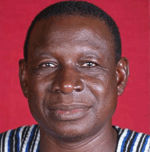
Deputy Minister Tia Alfred Sugri.
(Government of Ghana)
|
Sources: Daily Guide, Business and Financial Times, Ghana Business News, X FM News Center.
The Government of Ghana announced that it's studying tariff and non-tariff measures to restrict the importation of poultry products, after local analysts warned that those purchases are harming the national economy. "Imported chicken is being sold at below the cost of local chicken, and farmers in Ghana cannot simply compete, resulting in the collapse of dozens of farms and the loss of hundreds of jobs," said Yaw Graham, expert of the Third World Network-Africa (TWN-A), focal point of Social Watch.
|
Published on Tue, 2010-11-16 14:44
The gender unit of TWN-Africa is hosting a round-table on gender and regional economic integration in Africa on 18-19 November, 2010, in Accra, Ghana. The meeting brings together scholars, feminist economists and gender experts, as well as policy-makers, to discuss issues of gender equity and Africa’s economic integration.
|
|
Source: 
. Published on Wed, 2006-11-15 13:08
Author:
Isabella Gyau Orhin
|
|
Source: 
. Published on Fri, 2005-09-16 16:46
|
|
Source: 
. Published on Wed, 2004-12-01 16:38
Author:
Martin Luther Otu
|
|
Source:
. Published on Wed, 2004-12-01 16:38
Author:
Martin Luther Otu
|
SUSCRIBE TO OUR NEWSLETTER
Submit
|