India
Achieving the SDGs: Rhetoric and reality The Government of India presented its first Voluntary National Review (VNR) report on Implementation of the Sustainable Development Goals (SDGs) to United Nations in 2017. Despite VNR guidelines urging countries to inform on “progress and status of all SDGs”, India reported on only seven goals. This is surprising as India’s VNR claimed its national development goals are “mirrored in the SDGs” and as Government had asserted 11 of 17 SDGs were already being worked on even before the SDGs were adopted. Given the consensus that SDGs’ success largely depends on India’s achieving them, an appraisal of its performance in critical social sectors, including those associated with the SDGs left out of VNR, becomes necessary.
Published on Thu, 2020-01-30 10:08
In India the official VNR's main point is that rapid economic growth has sharply reduced poverty. A 2018 study backs this claim saying extreme poverty is declining in India at rate of 44 people per minute as a result of which, since May 2018, India claims to no longer have the largest number of poor people. Despite this dramatic poverty reduction, over 73 million Indians still live below the international poverty line. Most of these people subsisting on less than US$1.90 a day are in rural areas. Even as the absolute numbers of poor fall there is rapid rise in inequality. A 2018 Oxfam report says India’s richest one percent garnered 73 percent of national wealth generated in 2017.
|
Published on Fri, 2019-04-12 09:27
The Government of India presented its first Voluntary National Review (VNR) report on Implementation of the Sustainable Development Goals (SDGs) to United Nations in 2017. Despite VNR guidelines urging countries to inform on “progress and status of all SDGs”, India reported on only seven goals. This is surprising as India’s VNR claimed its national development goals are “mirrored in the SDGs” and as Government had asserted 11 of 17 SDGs were already being worked on even before the SDGs were adopted. Given the consensus that SDGs’ success largely depends on India’s achieving them, an appraisal of its performance in critical social sectors, including those associated with the SDGs left out of VNR, becomes necessary.
|
Published on Mon, 2018-04-16 00:00
The Indian state government of Tamil Nadu this year presented a Gender Budget Statement as part of the annual budget documents, quantifying the allocations that will benefit women during this fiscal year. Finance Secretary K. Shanmugam said it is the first time such an exercise has been undertaken. Kamakshi Sundaramurthy, senior researcher of Social Watch Tamil Nadu, said the gender budget does not address the needs of sub-categories among women, such as those from among the minorities, Dalits and sub-castes. “These women need better education, healthcare and hostel facilities. Employment is also critical for their empowerment. They need the gender budget more than any of us but remain excluded,” Ms. Sundaramurthy said.
|
Published on Mon, 2017-12-11 10:51
In India, PPPs are expected to mobilize about half of the US$ 1 trillion target for infrastructure investment by the end of the 2012-2017 Five Year Plan. The government has been actively promoting PPPs in many sectors of the economy and the report by Social Watch India presents a mixed picture. Many of the highway/road construction projects like Golden Quadrilateral and seaports like the Jawaharlal Nehru Port Trust (JNPT) have been deemed a success.
The report observes, however, that “many times PPPs are good in theory, but in practice… they have transmogrified into avenues for the realtors to become rich at the cost of the tax payers”. Some promoters who excelled at gold-plating projects 'persuaded' public sector banks to lend on questionable assumptions and collateral. These promoters took out their equity money in the construction phase and exited the project under various conditions. Given India's rank in 'enforcing contracts' of 178 out of 189 countries, this should cause little surprise, since PPPs are essentially contracts. The biggest losers have been Indian citizens. Public sector banks now have a pile of stressed loans, which can now be remedied only by recapitalization from the tax payer.
|
Published on Wed, 2017-07-12 15:19
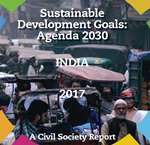
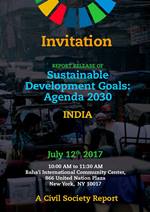
The ‘Civil Society Report on SDGs: Agenda 2030' of INDIA 2017 will be released on 12th July 2017 at Baha'i International Community Center, 866 UN Plaza, New York from 10:00 AM to 11:30 AM. The launching will be held in the framework of the HLPF 2017
Download the report here.
|
Published on Thu, 2016-08-25 13:26
 |
India is one of the world’s emerging economies, with impressive economic growth. While this growth has increased the income of a very small section of the population, India has the largest number of poor people in the world. The country has the world’s third largest number of billionaires and still millions of children are out of school; many millions of children do not live to the age of five; many millions of mothers die in childbirth. Despite economic growth, the country faces challenges of social and economic inequalities, urban-centred economic growth and shrinking civic spaces. While economic growth indeed made a difference to the large middle class, it is yet to ‘trickle down’ to rural poor, farmers and a vast number of poor and marginalized people, including Dalits (Scheduled Castes) and Adivasis (Scheduled Tribes), which make up 25 percent of the population. The environment is under increasing stress and there is a vibrant discussion about the consequences of mining and other disruptive activities on forests and environment and the implications for climate change. On the one hand, economic growth provides resources for greater investment in achieving the Sustainable Development Goals (SDGs), and on the other, the urban-centric growth model, and increasing instances of crony capitalism also result in rising inequality and shrinking democracy and civic spaces and pose a challenge to effectively realize the 2030 Agenda and its SDGs.
|
Published on Fri, 2014-08-22 15:00
The latest Citizens’ Report on Governance and Development prepared by the National Social Watch has drawn attention to several disturbing trends in India, comments Bharat Dogra in the latest issue the influential "Mainstream" weekly. The findings of this report are supported by a wealth of facts and figures, says the review.
|
Published on Sat, 2014-05-31 00:00
Book Review By Prof Kuldeep Mathur
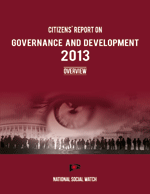
The Citizens Report on Governance and Development 2013 is the seventh Citizens’ Report of National Social Watch.
Democracy is not an easy system of governance. It is fragile and its essence cannot be guaranteed only because there is an assurance of periodic elections. Its fragility is dependent on several factors among whom is the way its governing institutions function and the kind of policies that are determined by them. This requires constant vigilance lest the people who come into power and institutions that they oversee function according to the mandate given to them by the people who have elected them go astray. This vigilance can be exercised only if there is information available to the people. Thus, transparency and availability of information is critical to hold then accountability.
|
Published on Thu, 2014-05-15 19:24
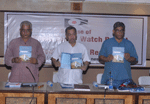
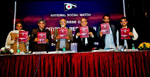
The National Social Watch Report and the Odisha Social Watch Report 2013 was launched on Tuesday 13th May 2014 in DRTC-CYSD, Bhubaneswar, India. Mr. Jagadananda, President of National Social Watch, presented both the reports, followed by the presentations of the findings of the reports and open discussions.
Dowload the Citizens' Report on Governance and Development 2013 and Odisha Social Watch Report 2013.
|
Published on Thu, 2014-05-15 09:21

Gustave Assah.
|
The participants in the civil society strategy meeting on monitoring and accountability organized by Social Watch last february in Montevideo were asked about how they personally work and relate with the huge task of making the powerful accountable. Here is what they said:
|
Published on Thu, 2013-12-19 13:46
The National Social Watch Report on Governance and Development 2013, released today in Delhi, highlighted that 31% of MPs in Lok Sabha has pending criminal cases against them. The average salary package of each MP is 68 times higher than the percentage income in the country and total value of assets of 4 MPs is Rs. 29.2 billion.
This report was released by Honorable Justice Ananga Patnaik, Supreme Court of India and Shri Satyanand Mishra former Chief Information Commissioner, Central Information Commission.
Chief Guest Justice Ananga Patnaik said “this report gives an overview of our institutions”. He further added that giving only statistics would not work with parliamentarians and legislators. Give them suggestions as well. They may not accept them today and tomorrow they will be accepted.
|
Published on Thu, 2013-12-05 14:55
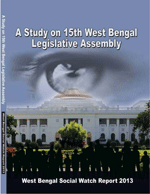
West Bengal Social Watch releases a Citizen’s Report on the performances of the 15TH West Bengal State Legislative Assembly till date. West Bengal Social Watch organized a ‘Discussion Meet on Current State of Affairs vis-à-vis Role of Citizens’ on November 30, 2013.
Shri Chittotosh Mukherjee, former Chief Justice of Kolkata & Mumbai High Courts participated in the Press Conference hold on November 30, 2013.
The citizens have therefore the right to know how their representatives are discharging their duties in the Assembly. The report is an attempt to provide some basic information about the West Bengal Legislative Assembly and, in particular, about the functioning of the present Assembly (15th Assembly), which was constituted in May 2011.
|
Published on Thu, 2013-10-03 14:55
Speaking at the UN General Assembly articulating the Indian civil society aspirations on actions to make the new development agenda work in developing nations that are home to 85 percent of the world's poor, Amitabh Behar representing National Social Watch (India) and Wada Na Todo Abhiyan emphasized that, “for the new development agenda to succeed, we need to move away from a poverty lens to a more holistic justice frame.” The new development frame will succeed the current Millennium Development Goals (MDGs) that expire in 2015.
Mr. Amitabh Behar, a representative of a coalition of 4,000 Indian civil society organisations under the umbrella National Social Watch and Wada Na Todo Abhiyan, voiced the civil society concerns related to the new development agenda at the UN Special Event on MDGs at the 68th General Assembly in New York on September 25.
|
Published on Thu, 2013-05-02 10:55
Unlike many developing countries, India’s economy has been growing at a fast pace, enabling the government to mobilize the necessary resources internally for the achievement of the Millennium Development Goals (MDGs) by 2015. Its dependence on international aid, especially for financial resources is minimal; in fact it has declined bilateral aid from many countries. Despite this, however, the country has failed to achieve most of the goals and targets. The main reasons for this are inadequate funding, inappropriate administration and ignorance of policy and governance issues.
Ultimately however, the failure is due to the absence of inclusiveness in the development model. Instead of enabling people to acquire basic needs such as food, sanitation, water, health care, the government is promoting ‘non-inclusive growth’ and has sought to provide basic services through subsidies with the associated problems of inefficiency and corruption.
|
Published on Mon, 2013-04-22 14:23
Bangalore - After independence, we got bureaucracy not democracy, said Bhaskar Rao Gorantla, Research Director of National Social Watch (India). He was addressing a gathering of civil society representatives at a consultation programme organized by the Karnataka Social Watch on administrative reforms.
Listing various structural problems in the administration, he said that although the central and state level administrations have undergone a positive change since independence, the district/local level administrative bodies have not undergone any significant changes.
|
Published on Fri, 2012-11-16 06:43
Gujarat Social Watch has come up with study and analysis of the works of this Indian state Legislative Assembly-10th session of 12th assembly, as the elections are due in December this year. The book “Vidhantantra-Am Adami Ni Najare” is an effort to promote public engagement and improve accessibility and accountability to the members of this parliamentary body.
|
Published on Thu, 2012-11-08 09:25

Gujarati Legislative Assembly.
|
Gujarat Social Watch (GSW, member of Social Watch India) revealed this week, in its review of the 10th session of the 12th Gujarati Legislative Assembly, that the chief minister (head of the state government) Narendra Modi spoke only three times in the entire session, which lasted 30 days.
|
Published on Tue, 2012-09-04 17:18
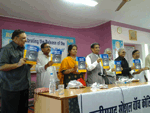
Photo: Social Watch India
|
Central and local authorities’ failures are responsible for the gloomy performance of the health sector in Indian state of Chhattisgarh, according to the most recent report produced by the local Social Watch coalition. The governments must be held accountable for the fulfillment of this Constitutional and basic right, but the citizens also have the responsibility to monitor its implementation, activist said while they released the study.
|
Published on Wed, 2012-08-22 08:53

Ranja Sengupta.
(Photo: Civil Society News)
|
In India, where economic, social and gender inequalities persist historically, and where trade policies are not 'gender neutral' the impact of trade policy on women must be paid serious attention to. Ranja Sengupta, senior researcher with the Third World Network (TWN), is worried that as the country climbs up the ladder of an emerging economy, the health, education and food needs of women get affected.
|
Published on Tue, 2012-08-14 08:47
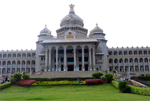
Photo: Karnataka Legislative
Assembly.
|
In an indication of elected representatives’ apathy to people’s causes, 129 of the 224 legislators in the Indian State of Karnataka have never posed a single question during the Legislature sessions held last year, revealed the Karnataka Social Watch Report 2012, according to The Hindu newspaper.
|
Published on Thu, 2012-05-10 13:58
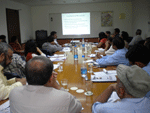
Photo: Social Watch India
|
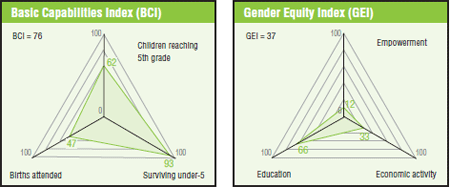
Social Watch India organized two half-day workshops, the first on the Basic Capabilities Index (BCI) and the Gender Equity Index (GEI), and the second on National Minorities Commission.
|
Published on Thu, 2012-03-15 13:19
In terms of gender equity India is in critical condition. The South Asian giant is below the already dim regional average, and its only neighbour presenting a wider gender gap is Pakistan, one of the countries in worse gender situation in the entire world.
|
Published on Thu, 2012-03-01 07:29
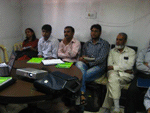
Photo: Social Watch India
|
“The notion of evaluating social development on the basis of economical growth should change, as the studies from different aspects reveal the growing disparities in the societies across the globe,” said Dr.Yogesh Kumar, Executive Director of Samarthan and National Convener of Social Watch India. Kumar was talking in Bangalore at the launching of the Social Watch Report 2012.
|
Published on Tue, 2012-01-24 07:42

In Delhi, Jangpura Extension.
(Photo: April May/Flickr/CC)
|
The people have been facing different kinds of deprivation and inequality in the Indian cities, according to a UNESCO study on the India urban policies reported by Governance Now analysis portal. “There are inequality, ghettoisation, apartheid and segregation across the cities in India,” said Miloon Kothari, former UN special rapporteur on adequate housing.
|
Published on Mon, 2011-09-19 12:24
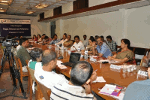
The debate conducted by
Social Watch and Governance Now in New Delhi
(Photo: Chinky Shukla/Jesudasu Seelam)
|
Sources: Social Watch India, Governance Now
Do regional parliamentarians have a voice in Indian democracy? What is the role of parliamentary committees? What exactly is the ambit of a parliamentarian? Questions like these were debated at “People, Parliament and Performance”, a discussion conducted by Social Watch India in partnership with Governance Now magazine in New Delhi.
|
Published on Tue, 2011-07-19 07:20
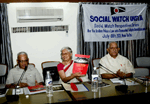
Social Watch India launched its
latest report. (Photo: SWIndia)
|
Source: Social Watch India
Most of the 70,000 complaints filed every year at the National Human Rights Commission of India “are against police”, said Dr. K. S.Subramanian, former policeman and author of the report “Social Watch India Perspective Series Vol.:3”, launched last week.
|
Published on Fri, 2011-07-08 09:10
Source: The New Indian Express.
The new figures set by the Indian government to define poverty (an income of USD 0.45 a day for urban people and one of 0.33 for those living in rural areas) are “abysmally low”, wrote Himanshu Jha, the national coordinator of Social Watch India, in his most recent column for The New Indian Express, one of the major newspapers of his country. The politics fixed according to these indicators can exclude “a large section of the population” that needs aid from “the available social security net, which in this country is minimalist by any standard,” he warned.
Jha’s column reads as follows:
|
Published on Wed, 2010-12-15 15:31
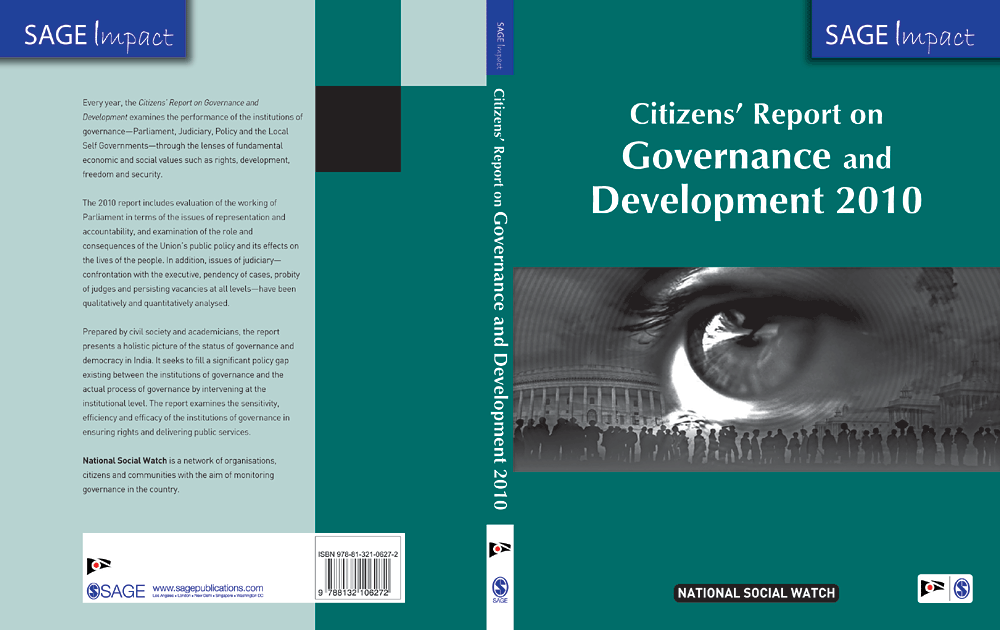
Source: National Social Watch Coalition India (NSWC)
The 2010 report of Social Watch India, to be launched in Delhi next Tuesday December 21st, includes evaluation of the working of Parliament in terms of the issues of representation and accountability, and examines the role and consequences of the Union’s public policy and its effects on the lives of the people. In addition, issues of judiciary - confrontation with the executive, pendency of cases, probity of judges and persisting vacancies at all levels- are qualitatively and quantitatively analysed.
|
Published on Mon, 2010-05-10 16:37
 The dynamics of International Financial Institutions and private capital in the globalized world has often acted as delimiting factors to state sovereignty. The role of Social Watch as a ‘watch dog’ gains significance in the current context of multiple crisis stressed the Pan-Asian Workshop: "Who pays? The global crises and what needs to be done – an Asian perspective" held in New Delhi, India, 22- 24 February 2010. The dynamics of International Financial Institutions and private capital in the globalized world has often acted as delimiting factors to state sovereignty. The role of Social Watch as a ‘watch dog’ gains significance in the current context of multiple crisis stressed the Pan-Asian Workshop: "Who pays? The global crises and what needs to be done – an Asian perspective" held in New Delhi, India, 22- 24 February 2010.
|
Published on Wed, 2009-11-25 03:00
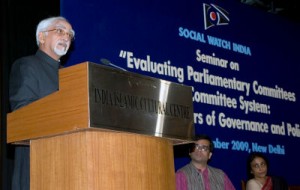 First published by The Times of India First published by The Times of India
NEW DELHI: In a scathing indictment of the parliamentary committee system, an independent report has said that leave alone acting as watchdogs, committees were vulnerable to manipulation. The report — Evaluating Parliamentary Committees and Committee System — prepared by the National Social Watch Coalition elaborates with examples how committees have been used by the government to serve its ends.
|
|
Source: 
. Published on Wed, 2009-05-27 17:55
|
|
Source: 
. Published on Tue, 2009-04-21 14:38
|
|
Source: 
. Published on Tue, 2009-04-21 14:36
Author:
Ranen Kumar Goswami
|
|
Source: 
. Published on Tue, 2009-04-21 14:33
|
|
Source: 
. Published on Thu, 2009-03-19 17:47
|
Published on Thu, 2009-03-19 11:27
Next month in India, the “world´s largest democracy” will begin a process of national Parliamentary elections for the first time since 2004, in a critical moment in which issues related to security and to the economy are weighing heavily on voters´ minds. Taking this context into account, this month´s “Spotlight On…” column will focus on the Social Watch India coalition, whose work to promote transparency and accountability in politics will be crucial during this election period.
|
Published on Fri, 2008-09-26 12:39
Social Watch India released the first perspective paper on “Law Under Globalization” which provides an insight into recent trends in both law making processes and judicial behaviour, with a stress on how the logic and instruments of globalization are directly affecting the rule of law.
|
Published on Mon, 2007-09-10 13:31
A civil society delegation representing the National Social Watch Coalition (NSWC) engaged in a meaningful interaction with the Planning Commission around the Citizens' Report on Governance and Development 2007 and the monitoring of the key institutions of governance namely Parliament, Executive- Policy, Judiciary and Local self Governance. Deputy Chairperson of the Planning Commission Mr. Montek Singh Ahluwalia and the Planning Commission Members actively participated in the discourse.
|
|
Source: 
. Published on Mon, 2007-08-27 14:50
|
|
Source:
. Published on Mon, 2007-07-09 12:18
|
Published on Fri, 2007-06-15 11:25
The Social Watch India Report 2007 will be released on 30th June 2007 at Stein Auditorium, India Habitat Centre, New Delhi . The report focuses on the performance of institutions of governance namely the Parliament, the Executive, the Judiciary and the institutions of local self governance from a human rights perspective. The Social Watch India Report 2007 emphasizes the importance of ensuring these Rights to vulnerable sections such as the tribals, the dalits, the poor and the women.
|
Published on Thu, 2007-06-14 15:10
Andhra Pradesh Social Watch Coalition & Dalit Bahujan Shramik Union invite to the Release of A.P. Social Watch Report 2007 that will be held next Tuesday 22nd May 2007, Indira Park, Hyderabad.
|
|
Source: 
. Published on Wed, 2007-05-16 14:38
|
|
Source: 
. Published on Tue, 2006-08-29 17:21
|
|
Source: 
. Published on Wed, 2006-03-01 14:23
|
|
Source:
. Published on Thu, 2006-02-16 11:05
|
|
Published on Wed, 2006-02-15 14:20
|
|
Source: 
. Published on Wed, 2005-09-07 12:21
Author:
Geetha N Bhardwaj
|
Source: Mines & Communities. Published on Tue, 2005-08-02 14:32
This week sees the launch of a major critical report on India's largest mining company, Vedanta Resources plc, based in London.
|
|
Source: 
. Published on Mon, 2005-07-25 10:49
|
Published on Wed, 2004-12-01 16:38
The National Social Watch coalition launched the "First Citizens Report on Governance and Development" on June 9, 2003, in New Delhi, India.
|
|
Source: 
. Published on Wed, 2004-12-01 16:38
|
SUSCRIBE TO OUR NEWSLETTER
Submit
|