
Korea, Rep.
Implementing the SDGs
In South Korea, an institutional arrangements for sustainable development were established in 2000 in the form of the Presidential Commission on Sustainable Development (PCSD), following which the Framework Act on Sustainable Development was passed as a fundamental law in 2007 and came into force in 2008. From 2000 to 2008, the PCSD acted as a presidential advisory body, and the Government and National Assembly worked together on national strategies for sustainable development implementation. However, by 2010, the Framework Act on Sustainable Development had been revised and put under the Framework Act on Low Carbon and Green Growth, and the Committee on Sustainable Development (CSD) fell under the jurisdiction of the Ministry of Environment. As a result, subsequent five-year sustainable development plans were concentrated on the area of the environment, no longer reflecting the general state of the nation.
Published on Thu, 2016-07-14 20:47
South Korean society is currently experiencing rising economic inequality, against which Government policy has done nothing to stop. The current regime and the ruling party are distancing themselves from the implementation of the SDGs that relate to economic inequality and democracy. Instead, new laws make it easy for chaebol (mega corporations) to accumulate wealth, while weakening fundamental consumer rights and protections and the new Anti-terrorism Act, adopted in March 2016 includes provisions threatening democracy. |
Published on Mon, 2013-03-04 23:00
Since the end of the Korean War in 1950, the country has achieved sustained economic growth. GDP, which at that time was US$ 67, doubled in a decade, between 2000 and 2010, Korea joined the OECD in 1996 and achieved most of the Millennium Development Goals (MDGs). But inequality, as a side effect of economic growth, is present. There is no more extreme poverty but diversified poverty, and society still has challenges that are not shown by the indicators. The government's economic policy has encouraged assembling industry export-oriented with cheap labor. Between 2000 and 2009, relative poverty rates for children, seniors and women increased. Poverty is concentrated in the elderly at female level, low education, vulnerable health and in rural areas. It is clear that the government needs to implement policies to reduce socioeconomic inequality that go beyond reducing inequity and poverty, by creating quality jobs and social protection programs. |

Published on Wed, 2012-10-24 13:02
Affiliates of South Korea's top 10 conglomerates still prefer former government officials and ex-policymakers as outside directors, reported Yonhap news agency. The Citizens' Coalition for Economic Justice (CCEJ, national focal point of Social Watch), says that "enhancing independence will reduce the chance of these posts being used for lobbying since companies will not be as able to influence outside directors as they could in the past." A total of 330 people served as outside directors at the 93 affiliates of the leading conglomerates as of end-June this year, down from 337 a year earlier, according to the data compiled by local research firm Chaebol.com. |

Published on Fri, 2012-09-07 10:09
Civic groups have charged the President of the Republic of Korea Lee Myung-bak of saddling Seoul residents with losses while he was mayor of the capital city, by signing an unfair contract with a leading private sector infrastructure fund to build a metro line, reported journalist Park Hyun-chul on The Hankyoreh daily newspaper. |

|
Published on Thu, 2012-03-15 11:04
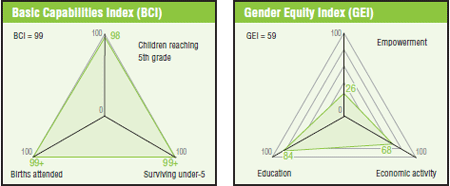
In terms of gender equity the Republic of Korea is far below the East East Asian average, although in a better situation than its bordering neighbours. |
Published on Fri, 2011-12-02 07:43
Civil society organizations that participated in the High Level Forum on Aid Effectiveness held this week in Busan, South Korea, regretted that the deal reached at the conference was not binding for all the donor countries, and the lack of a rights based approach, especially on gender, and of commitments on favorable conditions for the NGOs. |

|
Published on Fri, 2011-07-08 09:13
Source: Yonhap News report cited by The Korea Herald. The number of affiliates of South Korea’s 15 largest chaebols has increased about 65 percent over the past four years, as those huge family-run business conglomerates have aggressively expanded their territory in the construction and real estate industries, reported this week the civic group Citizens' Coalition for Economic Justice (CCEJ, focal point of Social Watch). |
Published on Fri, 2011-05-27 07:55
Sources: Yonhap report,The Korea Times report More than half of the senior advisers at six major South Korean law firms are former bureaucrats with expertise in finance, warned this month the Citizens' Coalition for Economic Justice (CCEJ, national focal point of Social Watch). |
SUSCRIBE TO OUR NEWSLETTER
 |
