Eritrea
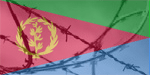
Engineering a failed State Once praised as one of the most promising countries in Africa, the country has become the victim of an
authoritarian and militarized regime. The country has rapidly descended into intolerable levels of political
repression, leading to abject poverty and “social anomie,” an environment that precludes fulfilment of its
international commitment to sustainable development, economic growth and progress. The fundamental
obstacle of political repression can only be removed with the help of outside pressure on the Eritrean
Government.
Published on Thu, 2017-03-16 21:01
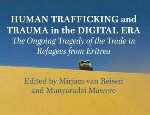
The book entitled "Human Trafficking and Trauma in the Digital Era: The Ongoing Tragedy of Trade in Refugees from Eritrea" sheds new light on the thriving business of human trafficking for ransom with severe torture practices, also named Sinai trafficking, and traces back its origins. It presents the findings that show how money is made with the smuggling of Eritrean refugees and how the booming business runs with inhuman practices such as violence, hostage situations and torture. This comes with a detrimental effect to the Eritrean community, which suffers collective trauma due to bearing witness to abuse of family members and fellow nationals through mobile phones and digital social networks.
|
Published on Fri, 2016-11-18 09:38
UN Special Rapporteur Sheila Keetharuth presented her report to the Third Committee , calling on the General Assembly to adopt a resolution submitting the Commission’s report to the Security Council for a referral of the Human Rights situation in Eritrea to the International Criminal Court (ICC).
The report highlights the Human Rights situation in Eritrea where it states crimes against humanity has been committed by Eritrean officials since 1991. Allegations of enslavement, enforced disappearances, torture and other crimes were on the report. Keetharuth emphasised the need for accountability for these crimes.
|
Published on Fri, 2015-10-23 22:34
It has been reported that ten Eritrean footballers are seeking political asylum in Botswana after a World Cup qualifying match that took place between Eritrea and Botswana on 10 October.
According to the Sunday Standard, “[s]ources from within the Eritrean diplomatic service have revealed that Eritrea is piling pressure on Botswana to have the ten players repatriated” with concerns being expressed by the Eritrean Movement for Democracy and Human Rights (EMDHR) that plans to repatriate are under way.
|
Published on Mon, 2015-06-08 10:13
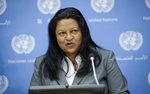
Special Rapporteur on the
situation of human rights in
Eritrea Sheila B. Keetharuth.
UN Photo/Amanda Voisard
|
The UN Commission of Inquiry on Human Rights in Eritrea has released a damning report about the situation in the country in the Horn of Africa. “It is not law that rules in Eritrea – but fear,” states the report. Some of the violations described in the report may constitute crimes against humanity.
|
Published on Thu, 2014-12-18 19:05
 |
An unapologetic Dutch blogpost by the chair of the Dutch YPFDJ, Meseret Bahlbi, gives an indication of the urgent need for a sober and realistic benchmarking of a process of change in Eritrea, which is heralded in some quarters. The YPFDJ is the youth wing of Eritrea’s only allowed political party. It has an active membership that actively sends out the messages of the party. Unashamedly Bahlbi is expressing the position of Eritrea’s Minister of Foreign Affairs Osman Saleh who called for an urgent review of European migration policies towards Eritreans. According to Minister Saleh these are “to say the least, based on incorrect information”. Bahlbi makes similar claims, suggesting further that his views are vindicated by a recent Danish report. Offering contradictory arguments, this report by the Danish Migration Service suggests returning Eritrean migrants home because of current changes in Eritrea.Human Rights Watch has criticised the report as deeply flawed. Meanwhile the Danish Migration Service has publicly expressed doubts on the content of its report.
|
Published on Thu, 2014-05-29 15:00
On Tuesday the 27th of May 2014, Mirjam van Reisen was interviewed by the Dutch newspaper the ‘Volkskrant’ concerning the human trafficking of Eritrean refugees. She explains that those in power in Eritrea richly profit from the human trafficking and even find ways to extort money from Eritrean refugees in Europe via taxation. In addition, it is likely that Eritrea also profits from the extortion of Eritrean families in Europe who pay human traffickers money in order to save their kidnapped relative.
An incredible amount of money circulates within these human trafficking practices and estimations surpass 600 million Euro’s in the last 5 years alone. In order to protect Eritrean refugees and in the attempt to stop these criminal practices, Mirjam van Reisen advises to close all Eritrean embassies in Europe, to better secure refugee camps where refugees are kidnapped from, and to cooperate with refugees to reveal and capture those responsible for these criminal practices.
|
Published on Wed, 2012-09-19 14:39
The Eritrean Movement for Democracy and Human Rights (EMDHR, national focal point of Social Watch) held a comprehensive seminar last week as part of its commemoration of the 18th September 2001, when Eritrean reformists and independent media journalists were kidnapped and disappeared since.
|
Published on Tue, 2012-07-24 09:09
In its last regular session this month in Pretoria, the General Council of the Eritrean Movement for Democracy and Human Rights (EMDHR, national focal point of Social Watch) took note of the worsening humanitarian, political and economic crises in the African country, and underlined that every effort should be exerted to bring about durable solutions for those who need protection.
|
Published on Fri, 2012-03-16 10:12
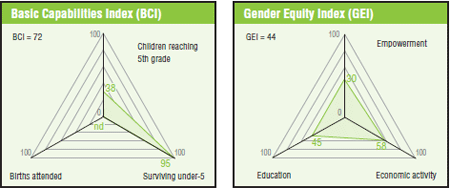
In terms of gender equity Eritrea lags well behind the Sub-Saharan African average, although is in a better condition than some of its neighbours.
|
Published on Wed, 2012-01-18 15:44

Mirjan van Reisen
|
Despite great attention paid to the Arab Spring, a ghastly silence prevails about the largest African ‘open air prison’: Eritrea is so isolated from the outside world that many inhabitants haven’t even heard about the revolutions in Libya or the uprising in Syria, wrote Mirjam van Reisen, founding director of the Europe External Policy Advisors (EEPA), a member organization of Social Watch network and based in Brussels.
|
Published on Tue, 2011-11-29 08:44
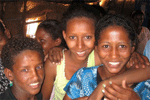
Eritrean refugees in Eastern Sudan.
(Photo: UN News Centre)
|
The European Union (EU) must support the people of Eritrea after the government of that African country decided to terminate its ongoing EU aid programmes, said Mirjam van Reisen, chair of International Social Responsibility at Tilburg University and director of Europe External Policy Advisors (EEPA).
|
Published on Wed, 2011-11-09 07:37
Mirjam van Reisen
|
The European Union (EU) should change its policy towards Eritrea, says Mirjam van Reisen, professor of International Social Responsibility at Tilburg University. The people are better of if the EU would spent its allocated subsidy for Eritrea on housing and education of the Eritrean refugees in Sudan, South Sudan, Libya, Egypt or Yemen, adds Van Reisen, also founder and director of Brussels-based Europe External Policy Advisors (EEPA).
|
Published on Fri, 2011-09-23 11:32
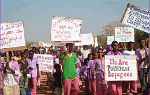
Eritrean refugees in a demonstration
(Photo: EEPA)
|
Sources: IDN-InDepthNews, EEPA
The European Union (EU) and the European Parliament censured the Eritrean President Isaias Afewerki for sending independent journalists and "thousands of Eritreans" to jail, and urged the African Union to exert pressure on the government to free prisoners. “Europe finally condemns Eritrea; but does it do anything to support the Eritreans?” asked Professor Mirjam van Reisen, founder and director of Brussels-based Europe External Policy Advisors (EEPA).
|
|