Thailand
Monitoring Sustainable Development: The State-Private Sector-People Nexus The cases below show some of the problems with partnerships for sustainable development. First, as implemented in Thailand, the SDGs are bounded by mindsets and practices of bureaucracy. Consequently, the goals are reduced to measures or mere numbers without recognition of the principle of development that must put human values and ecological concerns at the centre, so that many minority groups and ordinary people are overlooked (or invisible) and discriminated against. This stems from the second point: the imbalance of power in public-private partnerships. Our examples show that they are not initiated from below but from the centralized power of the corporate-government complex, strengthened by a curtailment of freedom of speech and continued neoliberal policies. This leads to our third point: lack of feedback. In order for implementation to be meaningful, a participation process should be organized regularly to ensure that diverse voices from below are taken seriously, especially those who are suffered or suppressed. In terms of an institutional framework, there must be effective mechanisms to monitor monopolizing conglomerates and practices that undermine health, environment and diverse local ways of life. Furthermore, local or indigenous forms of knowledge must be channeled into a broader public policy space; co-production of knowledge among various sectors (community, academic, expert, private company, entrepreneurial, etc.) and across many silos of knowledge should be supported in order to rebalance power relations and to enable local initiative and innovation to flourish. Above all, so-called ‘glocal’ networking is a crucial part in learning to accomplish the SDGs and to construct powerful partnerships.
Published on Tue, 2019-04-02 08:43
Writing from Thailand, Ranee Hassarungsee from the Social Agenda Working Group finds it impossible to constrain the analysis within national borders because “trade liberalization in the process of globalization has enabled transnational corporations to exploit natural resources widely and deeply across borders, in collusion with domestic elites. National-level natural resource policies have implications in other countries as State agencies, domestic monopoly capital and transnational corporations have assumed key roles in framing various aspects of development policies, in manufacturing, energy, environment, land use, etc.” The other side of the coin is that “people’s rights to self-determination is being restricted as their participation in decision-making is curtailed”.
|
Published on Sun, 2017-10-22 08:27
The SDGs have served as a pretext to include private sector representatives on high-level governmental bodies in Thailand. In the Sustainable Development Committee, civil society only plays a minor role when compared with businesses.
A government-initiated Civil-State (Pracha-Rath) policy aims to promote the role of the private sector in investment, establish cooperation between private sector and community enterprises and develop new agricultural schemes. Although this claims to help farmers by lowering the prices of chemical fertilizers, the Social Watch report notes that “the real intention is to boost the sales of these chemical agricultural materials”. The policy is “irrelevant to sustainable agricultural development” it claims, “because excessive usage of pesticides has always been a major problem for Thai farmers”.
|
Published on Fri, 2016-06-24 14:38
The Thai government has announced a “Pracha Rath” (State of the People) policy framework, but this “ironically has become a shared agenda between the Government and the industrial and corporate complex, enabling industrial and corporate interests to become the main drivers of development rather than the society and the citizen”.
The Thai Social Watch report 2016 describes a “development trap” with community self-reliance decreasing in rural areas. “As agro-industry takes over, farmers are becoming paid labor or even contract laborers on their own land. Land resources are being excavated mining and other extractive industries owned by by transnational corporations.” Meanwhile, development plans “call for big projects to facilitate the provision of resources, fuel, energy and transportation to the industrial sector and urban areas, causing under-reproduction of labor and damaging the environment”.
|
Published on Wed, 2016-01-06 09:33
The Thai government announced, mid-2015, a policy on child support providing grants for poor families. A monthly allowance of 400 baht per child will be given to children born between 1 October 2015 and 30 September 2016. The Ministry of Social Development and Human Security anticipates that about 135,768 new-born babies will be covered once the program is completed. Civil society wants social security to be recognised as a right and warns that the complexities of poverty and inequality in a changing society need to be better understood.
|
|
Published on Fri, 2015-10-30 20:56
|
Published on Sun, 2015-10-25 23:00
Twenty years have passed since the United Nations Fourth World Conference on Women was held in Beijing. Then, a parallel NGO Forum—entitled “Look at the World through Women’s Eyes”—was also held during the official conference. Over ten thousands of women from all over the world, including over 70 women from Thailand, participated. It was also the first time that Thai women at grassroots level took part in an international conference.
Many of these participating Thai women were very excited to find out that so many groups of women from different corners of the world shared common problems. The difficulties that affected women ranged from domestic violence to structural violence in society. For instance, poverty, conflict over resources, destruction of natural resources and the environment, changing pattern of women’s work, massive lay-offs, subcontraction of homeworking, and the informalization of formal labour sector. Several issues were new to the Thai women’s movement, such as economic globalization, structural adjustment programme, or certain significant but distant topics like peace and human security, militarization and arms trade.
|
Published on Thu, 2014-11-13 21:32
Thailand has been seen as a country with high economic development; however inequality in society persists and the income gap has become even wider. Data as of 2009 suggest that, 20 percent of the richest people in Thailand earn 11.9 times more than the 20 percent of the poorest. In 2012 it was found that the rich in the country possess 325.7 times more land than the poor. Reviewing government implementation of the Beijing Declaration and Platform for Action (BPA) has highlighted that the persisting gender discrimination has increased injustice in society for women and this situation is not being well addressed by the government.
The report, coordinated by Foundation for Women and Social Agenda Working Group (Social Watch, Thailand), is a summary from the report of the Thai women’s civil society groups on Beijing +20 review. The review process has provided an opportunity for civil society groups from different sectors, including groups working on issues related to public and private spheres and with diverse groups of women, to come together.
|
Published on Thu, 2014-09-18 10:21
Emerging social problems have shown that the characteristics of poverty in Thai society are becoming more complex, with differing forms of disparity and inequality. This basic understanding allows seeing the need to build a universal social welfare and protection system in Thailand because the current direction of development has marginalized the majority of the people. This situation has caused these people to become invisible. For example, migrant workers in Bangkok cannot access certain welfare services because their house registration is in the provinces. Therefore children’s problems cannot be resolved in isolation without linking them to other social issues.
At the same time, society faces various increasing social, economic and natural disaster risks. There are more exploitative practices in the employment system. This is the situation for the majority of parents and guardians of young children for whom civil society is advocating a basic early childhood welfare system.
|
Published on Mon, 2013-09-23 09:48
The Report Collecting Inputs from Marginalised populations on the Post 2015 Development Agenda says that in the last 15 years in Thailand there has been improvement in some important social services, such as education and healthcare, and people have grown more aware of their rights. However, rapid economic growth also widened the gap between different parts of the country and groups of people in the society, leading to marginalisation and growing disparities.
For many of these people life became more insecure: loss of source of livelihood (job, land, access to natural resources), identity crisis, deterioration of social relations, and disempowerment. This has been attributed by many to the economic development approach adopted over the years, which led to the commodification of natural resources and food. In parallel, public sector governance structure did not allow for significant people’s participation in the policy and decision-making processes at the local level.
|
Published on Thu, 2013-03-14 21:37
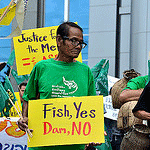
Thai villagers protesting
to stop the Xayaburi Dam.
(Photo: internationalrivers.org)
|
The approval of the 2010-2030 Energy Development Plan in Thailand will promote energy inequality among the population and the poorest will bear the heavy environmental costs of power plants, coal plants and even nuclear reactors, undermining the achievements of the MDGs that the country claims to have achieved by 2015.
Academics, civil society organizations and local community organizations have expressed their opposition, proposed a new plan based on a holistic approach to energy planning and urged to shift from the strong dependency on fossil fuel to use energy more efficiently using sources of renewable energy.
The latest Energy Development Plan (2010-2030), elaborated mainly by the Electricity Generating Authority of Thailand, is strongly influenced by the demands of the automotive and foundry industries, which will lead the national development plan for the next 20 years.
|
Published on Thu, 2012-03-15 11:09
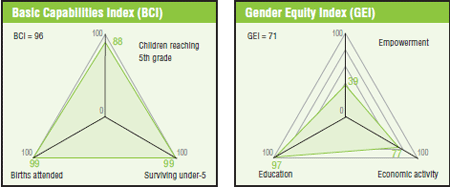
In terms of gender equity Thailand is slightly above the East Asia & the Pacific average, and all of its neighbours are in worse condition.
|
|