
Afghanistan
Published on Thu, 2016-06-30 23:15
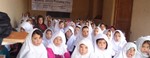
More than 9 million Afghans (over one third of the population) are not able to meet their basic needs and many more people are highly vulnerable to becoming poor because of the ongoing conflict and heavy reliance on agriculture and international aid as well as the lack of clear pro-poor policies. Women’s participation in the national Parliament (27%) is well above the global average of 21.8 percent, but gender norms in the culture and long walking distances to school in rural areas still prevent many girls to access education and violence against women remains a daunting challenge. The Afghan civil society report acknowledges that the country “has received an unprecedented amount of international development aid over the past 14 years”. This huge aid inflow “has benefited the country, buy it has also brought problems: corruption, fragmented and parallel delivery systems, poor aid effectiveness and weakened governance.” |
|
Afghanistan endorsed the Millennium Declaration and accompanying eight Millennium Development Goals (MDGs) only in March 2004 and added an additional goal to enhance security in order to recognize the critical role of peace and security in achieving the other MDGs. However, having lost over two decades to war, the country has had to modify the global timetable and benchmarks to fit local realities; therefore, 2020 was set for achieving its MDGs instead of 2015. The discrepancy between global and local timetables has created confusion and creates the risk of diverting the focus away from the 2030 Agenda for Sustainable Development.
The Afghan Government published the final report on its progress in achieving the MDGs in 2015. Because its findings - if challenged by independent watchdogs and shadow reports of the civil society - can be used as the baseline for the Sustainable Development Goals (SDGs), this report will look at the status of each of the MDGs in Afghanistan, and consider the implications for implementing the 2030 Agenda.
|
Published on Fri, 2013-05-24 00:00
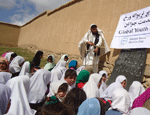
In September 2000, when the Millennium Summit was held at the UN General Assembly, Afghanistan was suffering from conflict and could not participate in the formulation of Millennium Development Goals (MDGs). The Government endorsed the Millennium Declaration as well as the MDGs only in March 2004. However, having lost over two decades to war, it has had to modify the global timetable and benchmarks to fit local realities. The rest of the international community defined the MDGs to be attained by 2015, against a baseline of 1990. Because of its lost decades and the lack of available information, Afghanistan has defined its MDG contribution as targets for 2020 from baselines of 2002 to 2005. Despite extreme poverty, ill health, and hunger, Afghans define the lack of security as their greatest problem. Hence the Government of Afghanistan has added this new goal to the eight global MDGs recognizing the critical role of peace and security in achieving the other MDGs. |
|
In September 2000, when the Millennium Summit was held at the UN General Assembly, Afghanistan was suffering from conflict and could not participate in the formulation of Millennium Development Goals (MDGs). The Government endorsed the Millennium Declaration as well as the MDGs only in March 2004. However, having lost over two decades to war, it has had to modify the global timetable and benchmarks to fit local realities. The rest of the international community defined the MDGs to be attained by 2015, against a baseline of 1990. Because of its lost decades and the lack of available information, Afghanistan has defined its MDG contribution as targets for 2020 from baselines of 2002 to 2005.
Despite extreme poverty, ill health, and hunger, Afghans define the lack of security as their greatest problem. Hence the Government of Afghanistan has added this new goal to the eight global MDGs recognizing the critical role of peace and security in achieving the other MDGs.
|
Published on Thu, 2012-07-05 12:06
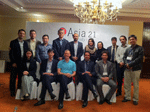
The Afghanistan Young Leaders Initiative, a non-partisan and non-political group of young people who share common values and beliefs to address the social, economic and political problems in the country, asked the Tokyo Conference on Afghanistan that will be held on Sunday 8 “a proper follow-up mechanism […] to ensure the promises delivered upon from both the […] government and its international development partners”. |
Published on Thu, 2012-05-10 14:00
The NATO Summit to be held later this month in Chicago “is unusual compared to previous summits as it will not reaffirm the allocation of more resources to its mission in Afghanistan, but the alliance will seek how to withdraw from a leading combat role in an increasingly unpopular decadelong war,” remarked the Afghanistan Young Leaders Initiative in a position paper issued last week. |
|
Published on Thu, 2012-03-15 11:47
In terms of gender equity Afghanistan is the country in worst situation throughout the entire planet. The country’s condition is far worse than those of the rest of the countries in South Asia, a region already presenting the widest gender gap on Earth. |
|
Decades of armed conflict and unrest have almost destroyed Afghanistan’s institutions and territory. Although the country has a new Government and a new Constitution, it faces major challenges in terms of sustainable development. One of these is how to ensure the right to education for both females and males. Despite remarkable progress in rebuilding the education system, the Government’s efforts have been insufficient and much remains to be done. Other challenges include tackling environmental problems and rehabilitating and managing the country’s natural resources.
|
|
Published on Fri, 2011-04-15 08:08
Source: CCPA Last November, Prime Minister Stephen Harper extended Canada’s mission in Afghanistan by three years without a debate in Parliament. His explanation: “When we’re talking simply about technical or training missions, I think that is something the executive can do on its own.” But the first four Canadian deaths in Afghanistan occurred in 2002, when a training exercise attracted “friendly fire” from an American F-16 fighter jet, warned Michael Byers and Stewart Webb in a new report published by the Canadian Centre for Policy Alternatives, focal point of Social Watch in the North American country, and the Rideau Institute. |
SUSCRIBE TO OUR NEWSLETTER
 |

