Germany
Youth Perspective of the implantation of SDGs in Germany and on the international Level
Published on Thu, 2022-09-15 19:54
Since the adoption of the 2030 Agenda on Sustainable Development, development finance has operated under conditions of low interest rates and high liquidity in global financial markets. This has changed with the recent turnaround in interest rates. The briefing paper Interest rate turnaround. A turning point for development finance? by Bodo Ellmers, describes the current trends, analyzes the implications for financing sustainable development in the Global South, and formulates policy recommendations on how countries in the Global South and their financing partners in the North can respond to the interest rate increases.
|
Published on Wed, 2020-12-09 13:35
An analysis and assessment of innovative policy options
In the early days of the COVID-19 pandemic, the United Nations (UN) estimated that developing countries needed an extra US$ 2.5 trillion in external finance to cope with the consequences of the crisis. This vast sum is needed because additional spending needs – for example on health services and social protection – coincide with a simultaneous collapse of all traditional sources of development finance: tax revenue, export earnings, migrant remittances, foreign direct investment and, to a lesser extent, also official development assistance (ODA).
In order to discuss how these finances could be mobilized, the governments of Canada, Jamaica and the UN Secretary-General launched the policy dialogue on “Financing for Development in the Era of COVID-19 and Beyond” at the UN in May 2020.
|
Published on Thu, 2020-08-27 14:21
A snapshot of the ongoing work at the United Nations in times of crisis
This briefing paper looks at the financing for development (FfD) work at the United Nations in 2020, an exceptional year due to outbreak of the global coronavirus crisis in the spring. Following this shock, FfD became a highly relevant issue on the UN agenda. The FfD process as originally scheduled was redesigned, with the FfD Forum originally scheduled for April cut down from four days of face-to-face meetings to a virtual session that lasted for just one hour. An official outcome document was adopted anyway, however free of concrete commitments that would match the needs of coping with the crisis.
|
Published on Mon, 2020-03-30 14:36
In addition to the health aspects of the virus, the global coronavirus crisis also has financial, socio-economic and developmental consequences. For this reason, a large number of policy measures have been announced by governments and international organizations, on the one hand to contain the pandemic, on the other to mitigate the economic consequences.
These measures contain for example fiscal stimulus and aid packages of various shapes and sizes, intended to cushion the serious economic and social consequences of the coronavirus outbreak worldwide. The main target groups of planned loans and cash injections are the healthcare system, as well as larger banks and companies. However, some strategies are also aimed at small and medium-sized companies as well as groups of individuals, their savings, private pensions and other private assets.
|
Published on Mon, 2020-02-10 08:31
In the 2030 Agenda governments committed to a revitalized Global Partnership between States and declared that public finance has to play a vital role in achieving the Sustainable Development Goals (SDGs). But in recent decades, the combination of neoliberal ideology, corporate lobbying, business-friendly fiscal policies, tax avoidance and tax evasion has led to a massive weakening of the public sector and its ability to provide essential goods and services and to fulfill its human rights obligations.
Public-private partnerships (PPPs) are promoted as the most efficient way to provide the necessary means for implementing the SDGs, but many studies have shown that privatization and PPPs involve disproportionate risks and costs for the public sector and can even exacerbate inequalities, decrease equitable access to essential services and jeopardize the fulfilment of human rights. An analysis by Jens Martens, from Global Policy Forum.
|
Published on Fri, 2019-10-25 08:29
Between partnerships and regulation – two diverging ways to tackle the problem at the UN
The new briefing paper “Extractive Industries and Women’s Rights: Between partnerships and regulation – two diverging ways to tackle the problem at the UN”, by Karolin Seitz and published by AWID, DAWN, Global Policy Forum and Rosa-Luxemburg-Stiftung, presents how women are disproportionately affected by negative social and environmental impacts of extractive industries. The briefing also explains why a new partnership between UN Women and BHP Billiton, launched in June 2018, is very problematic. Similar to UN Women, other United Nations (UN) entities are trying to attract partnerships with the corporate sector. As the case of UN Women shows, potential risks and side-effects of such partnerships are often not properly addressed.
|
Published on Mon, 2019-10-07 11:29
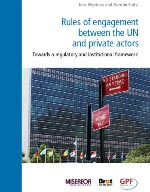
Global multi-stakeholder partnerships and initiatives between public and private actors, which move beyond traditional nation-state multilateralism, are now perceived as the future of international cooperation. The UN is already involved in hundreds of partnership initiatives with individual companies and business associations. ‘Rules of engagement between the UN and private actors,’ a paper by Jens Martens and Karolin Seit from Global Policy Forum, demonstrates that the existing guidelines are weak and highly heterogeneous. Effective and comprehensive rules for such cooperation are still missing.
The non-regulated engagement between the UN and the private sector could result in a loss of reputation, increased influence by private actors on political decision-making, and could divert scarce public resources away from UN goals.
|
Published on Tue, 2019-04-02 08:57
Governments have dedicated a pivotal role to the private sector in the implementation and financing of the 2030 Agenda and the SDGs. This has pushed a turn towards the private sector, the promotion of multi-stakeholder partnerships between public and private actors. However, far too often there is a considerable gap between the social and environmental commitments companies make publicly in political fora like the UN and the actual effects of their production patterns and investment strategies on people and the environment.
|
Published on Fri, 2018-07-06 00:00
The Private Sector and the Sustainable Development Goals
At the United Nations (UN) summit in September 2015, the 2030 Agenda for Sustainable Development with its 17 Sustainable Development Goals (SDGs) was adopted by all UN member states. The Agenda gives a comprehensive framework for a global socio-ecological transformation.
|
Published on Mon, 2017-09-11 09:23
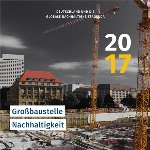
In its civil society shadow report a wide coalition of civil society organizations from Germany formulates analyses, criticism and recommendations for action in 17 areas, from poverty in old age to German foreign policy. The report opens with cross-sectoral analyses on areas that cannot be sufficiently located within the logic of the 17 SDGs, as for example, on the subject area ‘populism’ or the issue of international tax cooperation. The report also addresses the policies of the German government, whatever political configuration may come out after the federal election in September of 2017. The report concludes that "relying on a change in awareness of consumers and producers alone will not bring us closer to the goal of sustainability fast enough."
|
Published on Fri, 2017-05-26 15:48
Building capacity on tax matters is not just an issue for the global South, governments in the North should also strenghtend their own tax capacity, their own administration capacities when it cames to tax matters said Wolfgang Obenland, member of Global Policy Forum (GPF), Germany, who spoke at the event.
The event Follow-up and review of the financing for development outcomes and the means of implementation of the 2030 Agenda for Sustainable Development that was held last May 24th, 2017. The event took place in the framework of the second ECOSOC Forum on Financing for Development follow-up convened by the President of ECOSOC from 22 to 25 May 2017 at the United Nations Headquarters in New York.
|
Published on Fri, 2017-05-19 14:00
A new report examines the role that multi-stakeholder partnerships play in the implementation of the SDGs. The report warns of the risks, side-effects and dangers, as well as the opportunities, of such partnerships. The contributions deal with some of the major global partnerships in the area of food security, renewable energy and data availability.
|
Published on Thu, 2017-03-23 11:01
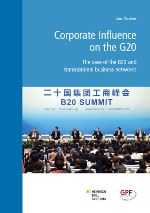
Over the past eight years, the G20 has emerged as one of the most prominent political fora for international cooperation. For transnational corporations and their national and international associations and lobby groups, the G20 process provides important opportunities to engage with the world’s most powerful governments, shape their discourse, and influence their decisions. For this purpose, business actors have created a broad network of alliances and fora around the G20, with the Business20 (B20) as the most visible symbol of corporate engagement.
A new working paper published by Global Policy Forum and Heinrich-Böll-Stiftung maps out the key business players and associations from the different sectors and branches involved in the work of the G20, and analyzes their core messages and policy recommendations.
|
Published on Mon, 2016-12-19 14:07
In an unprecedented and historic move, the Sixth Committee of the UN General Assembly recently granted observer status to the International Chamber of Commerce (ICC). The resolution was submitted by France, Albania, Colombia, the Netherlands and Tunisia and was adopted during the seventy-first session of the General Assembly. The resolution sets out the ICC’s position as observer in the General Assembly from 1 January 2017 on.
|
Published on Thu, 2016-12-01 15:10
The importance of global cooperation on tax issues is becoming more and more evident. The sums lost amount to hundreds of billions annually. While steps to curb the losses are underway, gaps in global tax governance remain both in the institutional setting and with regard to substantive issues. For example, there is still no body with universal membership that could discuss issues that are of particular importance to countries in the Global South. In order to fill these gaps, either existing institutions need to be further developed, or new ones established, or both. In any case, a new body would have to perform certain functions and meet particular criteria with regard to composition. A new paper formulates options for achieving this.
|
Published on Fri, 2016-09-16 09:15
The 2030 Agenda and its 17 Sustainable Development Goals (SDGs) comprises a number of goals which concern the internal situation in Germany. Among these are goals which derive from the human rights obligations, such as in the areas of education, health and social security. Examples include reducing the proportion of poor people in Germany by half and increasing the proportion of young people who complete secondary education.
Other goals address the external effects of German politics and economy. They demand domestic measures which also have immediate impacts for people in the countries of the South. These include goals for reducing resource use, for changing unsustainable consumption and production patterns, but also for the relationship to migrants and refugees.
|
Published on Fri, 2015-12-04 09:09
New study, released today by Global Policy Forum, examines the role and impact of philanthropic foundations in development. It addresses the impacts and side effects of philanthropic engagement by taking a closer look at the priorities and operations of two of the most prominent foundations, the Rockefeller Foundation and the Bill & Melinda Gates Foundation, in two crucial sectors, health and agriculture. So far, there has been a fairly willing belief among governments and international organizations in the positive role of philanthropy in global development. But in light of experiences in the areas of health, food, nutrition and agriculture, which are discussed in this working paper, a thorough assessment of the impacts and side effects of philanthropic engagement is necessary. The important role being allocated to the philanthropic sector in the 2030 Sustainable Development Agenda makes the discussion of its role a matter of urgency.
|
Published on Fri, 2015-09-25 08:46
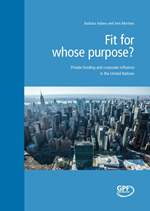
More than a hundred Heads of State and Government will gather in New York this week to adopt the 2030 Agenda for Sustainable Development. This agenda is intended to make the UN ‘fit for purpose’, but it is important to ask, ‘whose purpose will it be fit for’?
A new study from Global Policy Forum warns that the United Nations is embarking on a new era of selective multilateralism, shaped by intergovernmental policy impasses and a growing reliance on corporate-led solutions to global problems. The changing funding patterns of the UN and its funds, programmes and specialized agencies reflect these alarming trends. Key features are the growing gap between the scale of global problems and the (financial) capacity of the UN to solve them; the growing share of non-core contributions and earmarked trust funds in UN finance; increased reliance on the corporate sector; and the outsourcing of funding and decision-making to exclusive global partnerships.
|
Published on Fri, 2014-12-05 23:00
The principle of common but differentiated responsibilities (CBDR) is considered one of the key achievements of the UN Conference on Environment and Development in Rio de Janeiro in 1992. Twenty years later, this principle has become a focal point of current negotiations on climate change and the post-2015 agenda. The developing countries that make up the Group of 77 want to preserve the principle unchanged. However, the US, EU and other industrialized countries want to do away with it in its present form. They argue that global power structures have changed. In their view, fair burden sharing must include contributions to climate protection from emerging economies like China, India and Brazil. "If consensus cannot be found, there will be neither a new global climate treaty nor a global development agenda worthy of the name in 2015" writes Global Policy Forum's director, Jens Martens.
|
|
Source: 
. Published on Wed, 2014-06-25 00:00
When the United Nations began negotiating a Code of Conduct for Transnational Corporations (TNCs) back in the 1970s, the proposal never got off the ground because of vigourous opposition both from the powerful business community and its Western allies.
|
Published on Thu, 2014-05-15 09:21

Gustave Assah.
|
The participants in the civil society strategy meeting on monitoring and accountability organized by Social Watch last february in Montevideo were asked about how they personally work and relate with the huge task of making the powerful accountable. Here is what they said:
|
Published on Mon, 2014-03-03 15:43
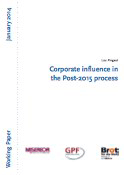
In a new working paper entitled "Corporate influence in the Post-2015 process" GPF's Lou Pingeot discusses the influence of transnational corporations in the Post-2015 process. This working paper by Brot für die Welt, Global Policy Forum and Misereor provides an overview of the main corporate actors in the post-2015 process and how they shape the discourse on development. The paper advocates for more transparency around the participation of corporations in UN processes, including their financial support to UN initiatives, and for more reflection on the risks of a corporate, private interests-driven development agenda.
The paper draws conclusions from its findings and makes recommendations for how to deal with corporate interests in global policy making in the future.
|
Published on Tue, 2013-04-23 14:01

Jens Martens. (Photo: IISD.)
|
The UN has launched an extensive worldwide discussion on the new development agenda that is to succeed the Millennium Development Goals in 2015. Jens Martens, long-time observer of international development and environmental policy, cautions in an interview against consultation overkill and calls on NGOs to develop alternatives that go beyond what is currently politically feasible.
|
Published on Mon, 2012-03-19 08:50
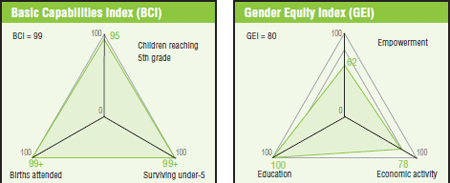
In terms of gender equity Germany places itself well above the European average, but below the Nordic countries and Spain.
|
Published on Tue, 2009-11-17 15:01
Wednesday 18 November 2009, 10:30.
In view of global crises, human rights must be enforced against economic interests!
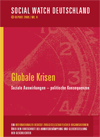
This Wednesday 18 November, the Germany Social Watch Report 2009, Globale Krisen – Soziale Folgen und politische Konsequenzen (Global Crises - Social impact and political consequences) will be launched in the Convention center in the building of the Federal Press, Room 0107
Schiffbauerdamm 40, corner Reinhardtstr. 55, 10117 Berlin
|
Published on Wed, 2007-05-16 10:43
Jens Martens (Global Policy Forum, SW Germany) co-chair of the SW Coordinating Committee summarizes the most recent trends, the possible issues on the agenda and the key events in the preparatory process for the 2nd Global Conference on Financing for Development (FfD) to be held in Doha in 2008.
|
Published on Tue, 2007-03-20 12:13
Bonn, 16 October 2006: In the past fifteen years, nearly one in every four countries has seen a decline in the quality of social services like education and health.
|
Published on Mon, 2007-01-22 14:54
In times of growing dissatisfaction with the groaning pace of the global negotiation process, and the current difficulties on the part of governments to engage in new compromises, multistakeholder initiatives and policy networks between private and public actors are experiencing a boom which appears to be expanding unfettered within the United Nations system.
|
Published on Tue, 2005-12-27 11:08
Endorsed by 28 organizations, the German Social Watch Report 2005 was launched in Bonn last October 21.
|
Published on Thu, 2005-03-17 10:30
Berlin/Osnabrück. On the occasion of the commemoration of the Tenth Anniversary of the Copenhagen World Summit (1995), German NGOs called for strengthening the fight against poverty and social exclusion. Last March 11, the Social Watch Germany representatives handed over to the Development Minister of that country, Heidemarie Wieczorek-Zeul (of the SPD), a catalogue of claims, which also included a protest for the insufficient actions undertaken regarding the resolutions adopted at the Copenhagen summit.
|
Published on Wed, 2004-12-01 16:38
The German edition of the 2003 Social Watch Report was launched at a press conference in Berlin on June 25, 2003.
|
Published on Wed, 2004-12-01 16:38
The German edition of the 2004 Social Watch Report was launched at a press conference in Berlin on July 1, 2004.
|
Published on Wed, 2004-12-01 16:38
Only the successful creation of a broad social participation in issues of international economic policy will make it possible to counter the social and ecological reprehensibility of neo-liberal globalization with a globalization of social justice and ecological sustainability.
|
SUSCRIBE TO OUR NEWSLETTER
Submit
|