Egypt
Egypt and the 2030 Agenda: No strategy for implementing the SDGs but continuous privatization following IFI policies
Published on Thu, 2020-05-14 12:11
The COVID-19 health crisis added to the multidimensional crises in the Arab region and their manifestation in conflicts, wars, economic and social inequalities, and the increasing number of refugees and migrants. It could lead to severe repercussions at the economic, social, and political levels. According to an ESCWA preliminary estimate, the region will lose at least USD42 billion in 2020 due to the Corona pandemic. ESCWA also considered that the global spread of the virus and the growing impact of low oil prices could aggravate income losses. Unemployment is expected to increase by 1.2 percentage points, meaning the loss of around 1.7 million jobs. The Arab region registers some of the highest rates of inequality around the world, and informal employment accounts for 50% of jobs. It also lacks universal social protection systems and is thus unable to protect workers and ensure their dignity during work stoppages.
|
Published on Fri, 2017-11-10 16:55
In Egypt the World Bank argues that the gains in mortality rates and life expectancy levels achieved since the beginning of the last century will not continue if the private sector is not involved, due to the government's failure to devote more resources to the health sector and a lower possibility of improving unhealthy daily habits of poor people.
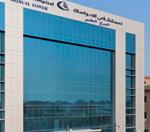
The Social Watch report notes that while the government has announced the creation of PPPs in the Smouha Maternity University Hospital and Blood Bank and Al Mowasat Hospital, the PPP central unit has not made public the details of the projects, nor the nature of the investors’ responsibilities. Nor has it announced the main investors in the projects or the improvements that they are expected to achieve. All that is known by civil society is that the PPPs will be implemented and partially managed by Bareeq Capital, DETAC Construction & Trading, Siemens Healthineers and G4S Company.
|
Published on Wed, 2017-09-27 15:09
The Arab NGO Network for Development (ANND) launched a book on the enabling environment of civil society in the Arab region. The publication aims to present an overview of the current situation of civil society organizations in Tunisia, Egypt, Lebanon, Iraq, Syria, and Palestine. It uses several country-specific indicators regarding the establishment of civil society organizations and their success. The current conflicts raging in the Arab region constitutes a serious challenge, especially in lack of attention to laws regarding the work of civil associations, in addition to the shifts faced in funding.
The publication highlights several legal challenges, especially those resulting from the lack of commitment to the principles of the separation of powers, as applied by democratic societies, as laws and regulations are often politicized. The book includes several recommendations to invigorate the work of civil society organizations in the regional, in order to consolidate the values of justice, equality, and sustainable development.
|
Published on Thu, 2017-08-31 12:30
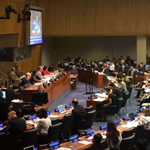
Following 8 days involving 43 Voluntary National reviews (VNR) and 147 side events with 77 ministry-level participations and 2458 registered stakeholder representatives, the statistical outlook of the 2017 High-Level Political Forum on Sustainable Development Goals is quite promising. It is only the second review and just two years after the kick-off for the implementation of a universal agenda towards leaving no-one behind. Yet, time is marching on and there is a long way to go on the level of implementation.
At the 2017 HLPF, Jordan became the third country from the Arab region to participate in the VNR process; following Egypt and Morocco in the 2016 review. The first words of Jordan’s national report made reference to the same issues: ‘the power of working together’ and taking into consideration ‘the urgent world issues’.
|
Published on Fri, 2017-05-12 15:43
“Informal labor is not a marginal issue in Arab countries. It is a core component of modern Arab economies and the distribution of work therein and is doomed to expand under current policies,” explained Samir Aita, lead researcher of the Arab NGO Network on Development (ANND) at the launch of the 2017 edition of the Arab Watch on Economic and Social Rights, last May 8 in Beirut.
The report, launched publicly at the American University, concludes that the “highest percentages of lack of formality are in countries with the least strict laws and bureaucracies, and vice versa. This goes against the stereotype that says that informality is a result of strict laws and bureaucracies.” It also concludes that “informal labor in Arab countries is mostly waged labor, except in rare cases, which contradicts another idea that says that informal labor is a choice, as young people entering the job market have no choice but to find any type of livelihood, no matter how fragile or temporary.”
|
Published on Thu, 2017-03-02 17:52
In the framework of its critical engagement in the 2030 Agenda, ANND launched an effort to document national programs for the implementation of the Sustainable Development Goals (SDGs) and socio-economic reform initiatives in the Arab region. This effort takes the form of national assessment reports and seeks to check if such implementation is made within a comprehensive rights-based development strategy, adopted with an inclusive, participatory and transparent approach.
The assessment reports link between monitoring and evaluation by Civil Society Organizations (CSOs) of the implementation of Agenda 2030 and other similar human rights monitoring mechanisms. They shed light on the necessity to adopt an inclusive social dialogue for policy making at the national level. With the limited resources available, the reports shall be made on a few countries (namely Jordan, Egypt and Morocco) and shall focus on 3 SDGs only:
|
Published on Mon, 2017-02-13 16:00
On November 29, 2016, the Egyptian parliament approved the draft law regulating the activity of civil organizations and institutions submitted by MP Abdul Hadi al-Qasabi on September 6, 2016.
This was tantamount to a declaration of war on civil society and an attempt to crack down on all active and supportive human rights organizations.
For more than 20 years now, the state has been committing a number of practices aimed to suppress and restrict these organizations and their members, but the recent parliament decision surpassed all previous practices.
|
Published on Fri, 2016-11-25 17:28
 |
Following the adoption of the draconian associations law in Egypt, six Political parties and 22 civil society organizations issued a joint statement to condemn and reject the proposed law. The groups noted that the new law effectively eradicates civil society and defers its administration to the government and security apparatus. They condemned parliament’s treatment of civil society as an enemy to be defeated through secret laws. In the statement, they reiterated that the state has already taken real steps to eliminate Egyptian civil society organizations by prosecuting case no. 173/2011 on foreign funding, and several organizations and their current and former directors have been banned from travel and have had their assets frozen. This new law, however, would pave the way for the eradication of any sort of civic action geared to development, charitable activities, and services. The operation of local development associations throughout Egyptian villages and hamlets, which provide services to local residents, will become nearly impossible.
|
Published on Sun, 2016-06-05 21:14
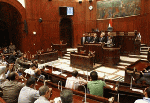
Constitutional Assembly
(Photo: ANHRI)
|
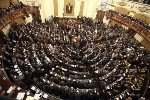
The defining feature of the framework for Egypt's national sustainable developmental strategy is the lack of a detailed roadmap to achieve several key goals, especially reducing poverty and unemployment and tackling the informal sector, for which it also lacks indicators. This is in addition to the lack of clarity in implementation mechanisms and the lack of consistency among the goals, despite the overarching strategy. The indicators used to measure the goals reflect the Government's continuation of the neoliberal approach, which is contingent on the development of the private sector and dependent on it to finance the development goals. Thus, for example, to reduce the deficit, the strategy does not include raising taxes on companies, instead opting to tax consumers, such as with the 10 percent value added tax (VAT). In addition, the strategy differs in important ways from previous development strategies, none of which were discussed in Parliament or through any sort of social dialogue.
|
Published on Wed, 2015-11-11 15:00
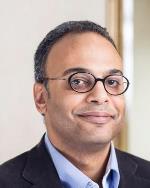
The arbitrary detention of Hossam Bahgat, (the founder of the Egyptian Initiative for Personal Rights, an independent Egyptian human rights organization and a journalist at Mada Masr, an online news site), on November 9th, 2015 is a mere reflection of the crackdown on civil rights in Egypt and the grim truth about the restricted enjoyment of the ‘’freedom’’ of expression and opinion in the country, that is essentially guaranteed by the Egyptian Constitution Article 651 and Article 19th of the International Covenant on Civil and Political Rights, that Egypt is party to.
|
Published on Fri, 2015-07-03 13:26
The peoples’ uprisings in the Arab region presented a golden occasion for revisiting the European Neighborhood Policy (ENP) and particularly the partnership between the Arab countries and the European Union (EU). The Joint Communication of the High Representative and European Commission, “A New Response to a Changing Neighborhood, ” highlighted important lessons learnt but remained an exercise of self-assessment without the engagement of EU partners and relevant stakeholders (including civil society) for what are widely considered today as major historical changes in the Arab countries.
|
Published on Tue, 2014-12-23 09:28
For the fourth successive year, a delegation of human rights and development civil society organizations from the Arab region will be visiting the European institutions in Brussels between the 8th and the 12th of December 2014. The Arab delegation includes civil society representatives from Egypt, Jordan, Palestine, Morocco, Syria, Tunisia and Lebanon.
This visit seeks to provide a platform for dialogue and exchange between civil society organizations from the Arab region and European policy makers at the Parliament and Commission around the EU’s support and involvement in the region.
|
Published on Mon, 2014-09-15 18:03
Serious developments regarding the violations of rights in Egypt are becoming more evident, as the Ministry of Social Solidarity proposes a new law, which would constitute a dangerous escalation in the framework of systematic targeting of civil society activists and the increasing restrictions imposed upon them.
On 26 June 2014, the Egyptian ministry in charge of regulating civil society organization proposed a new draft law, causing shockwaves among civil society organizations (CSOs) in the country. For six months, they had carried out negotiations with former Social Solidarity Minister Dr. Ahmed el-Boraei, which led to a proposed law to be presented to forthcoming parliament soon after the elections.
|
Published on Thu, 2014-05-22 22:54
The undersigned organizations condemn the security forces storming of the Egyptian Center for Economic and Social Rights, Alexandria Branch, and note that such attack is an expected escalation, amidst the growing incitement in the media, and defamation campaigns, which have been targeting human rights organizations and human rights defenders in Egypt.
Egyptian security forces, alongside security personnel dressed in civilian attire, raided the Alexandria Branch of The Egyptian Center for Economic and Social Rights, arresting 15, including two minors, and two ECESR staff, and confiscating several computers and documents. The arrested were taken to the Alexandria Security Department where they were held, until released hours later.
|
Published on Wed, 2013-12-18 19:08

Demonstration in Cairo.
(Photo: EACPE)
|
On December 19th, 2013 dawn in Cairo had witnessed an abusive raid against the headquarters of "the Egyptian Center for Economic and Social Rights" by the Egyptian police. The assaulters have kidnapped a photographer and two volunteers, tampered with the contents of the center, and seized some computers and documents. The kidnapped were taken to an unknown location. Up until the late hours of morning, the Egyptian center's lawyers were still searching for the kidnapped to commence the necessary legal procedures for their release.
The volunteers were preparing for a press conference called for by the Centre, to defend the rights of the workers of the “Iron and Steel Company” in Helwan, the “Swedish Cables” in Giza,”Santamora of blankets Tenth of Ramadan” and the Egyptian General Company for Tourism and Hotels" EGOTH "Shepherd”.
|
Published on Wed, 2013-11-13 20:14
As Egypt’s political crisis continues, its government will be asked to account to the United Nations for what has been done to address the social injustices which fuelled the revolution.
On November 14, Egypt will appear before the UN Committee on Economic, Social and Cultural Rights in Geneva, where it will be required to demonstrate how it has taken into account its human rights obligations as a party to the International Covenant on Economic, Social and Cultural Rights in navigating the country´s turbulent transition. This will mark the first time that Egypt has come before a UN human rights treaty body since the 2011 revolution.
|
Published on Fri, 2013-07-19 00:00
|
Demonstration in Cairo. (Photo:
EACPE)
|
The dramatic developments in the region carry positive indicators of a better future. Recent developments in Egypt reshuffled cards and underscored the fact that citizens are capable of getting hold of initiative and change once they feel their rights and their revolution’s achievement are in danger. The fact that more than 22 million people gathered in squares in all Egyptian cities after 22 million signatures were collected by the “Tamarod” movement, reiterates that peoples’ will is unbeatable and that people are capable of regaining their rights with their hands even after a while.
|
Published on Thu, 2013-03-07 23:15
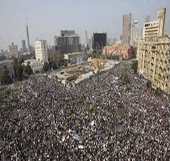
Demonstration at Tahrir Square,
Cairo.(Photo: EACPE)
|
Almost two years have passed since human rights and feminists organizations expressed their deep concern at the escalation of policies that reinforce impunity, do not protect citizens and do not guarantee the right of peaceful assembly. The exclusion of women from the public sphere through direct incitement and aggression must be condemned. The heinous crimes of sexual violence can not be separated from the decline of the social status of women.
The revolution of January 25, as the Egyptians call it, is the fourth in the last hundred and thirty years. The modern national movement has sought an effective national sovereignty, particularly with regard to economy and the ability to ensure socio-economic justice in the distribution of wealth and income. The Egyptian people discovered that without internal democracy it is impossible to preserve the conquests from previous revolutions. January 25 revolution asserts, then, the centrality of democracy, not only as a utopian goal, which practical implementation would be deferred indefinitely, but to lay the foundations of a modern, independent and prosperous country.
|
Published on Mon, 2012-11-26 08:03
|
Egyptian Constitutional
Assembly. (Photo: ANHRI)
|
The constitutional declaration issued by the Egyptian president Mohamed Morsi last week “contravened the revolution’s goals of democratization and exploited the expansive powers he granted to himself shortly after his election to arrogate unparalleled powers and immunize his decisions against judicial oversight,” warned 22 human rights organizations.
|
Published on Thu, 2012-10-25 10:37
Haggag Nayel.
(Photo: BHRM)
|
Reforming the Interior Ministry is not one of Egyptian president Mohamed Morsy's priorities, which allows police to continue attacking citizens with excessive force, according to 24 Egyptian human rights organizations, among them the Arab Penal Reform Organization, the Human Rights Association for the Assistance of the Prisoners, and the Egyptian Association for Community Participation Enhancement (national focal point of Social Watch).
|
Published on Tue, 2012-09-18 13:26
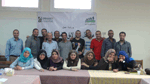
Photo: EACPE
|
Officially registered with the Ministry of Manpower earlier this month, Egypt’s first labor union of domestic workers is the result of an initiative by the Egyptian Association for Community Participation Enhancement (EACPE, focal point of Social Watch in that country), which launched a project to protect them last year.
|
Published on Thu, 2012-07-05 09:11
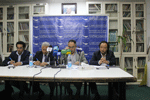
Press conference in Cairo.
(Photo: CIHRS)
|
Seventeen human rights non governmental organizations launched on Wednesday officially launched their “Human Rights in 100 Days” campaign to pressure new Egyptian President Mohamed Morsi to follow through on rights of Egyptian citizens.
|
Published on Tue, 2012-06-05 08:02
Seal of the EMMPE.
(Source: EACPE)
|
Despite the previous reservations, the first round of the Egyptian presidential elections held last week “can be described as fair and very close to conforming to international standards of transparency,” according to a broad alliance of civil society organizations and individuals that observed the polls, reported the Egyptian Association for Community Participation Enhancement (EACPE), national focal point of Social Watch in that Arab country.
|
Published on Tue, 2012-05-29 08:38
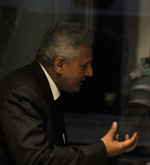
Magdy Abdel Hamid, from EACPE.
(Photo: European Partnership
for Democracy)
|
The first round vote for Egypt's next president has been criticized last week by international and local election observers who say that restricted access for monitors and minor violations have undermined the overall transparency of the process, reported journalist Nadine Marroushi for the Egypt Independent news portal.
|
Published on Tue, 2012-05-22 18:39
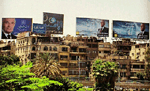
Egypt presidential elections posters
and billboards.
(Photo: gr33ndata/Tarek/Flickr/CC)
|
The Egyptian Association for Community Participation Enhancement (EACPE, focal point of Social Watch in the Arab country) said it would not monitor the presidential elections this week because of the restrictions placed on non governmental organizations by the government.
|
Published on Thu, 2012-03-15 11:39
In terms of gender equity Egypt is slightly above the Middle East and North African average, and far over neighbouring Sudan, although in worst situation than Israel.
|
Published on Wed, 2012-01-25 07:46

Project Rakeeb's symbol.
|
The third round of the elections in Egypt was a meaningful democratic exercise, with relatively few reports of violence or intimidation. The main irregularities were the widespread active political campaigning in and around polling centers, which resulted in sporadic violence, and the denial of access to observers, according to Project Rakeeb, a watchdog program run by two civil society organizations.
|
Published on Tue, 2011-11-29 08:54
The Independent Coalition for
Elections Observation is
supported by EACPE.
|
Egypt is holding the first phase of the parliamentary elections since Monday, in spite of the claims and recommendations to postpone them issued by political parties and civil society organizations, among them the Egyptian Association for Community Participation Enhancement (EACPE), focal point of Social Watch in this country.
|
Published on Mon, 2011-11-21 07:45
Thirty-nine Egyptian human rights and development organizations have drafted a new law to regulate NGOs and sent a copy to Prime Minister Essam Sharaf. The proposed law provides for the autonomy of Egyptian civil society organizations from the state and its administrative apparatus. At the same time, it guarantees the transparent operation of these organizations in terms of their activities and sources of funding.
|
Published on Fri, 2011-10-28 08:24
Individual and civil society organizations prepare parallel events in London, Berlin, Paris and Cairo on Monday Oct 31 to call on their respective governments to drop the debts accumulated by Mubarak’s regime in Egypt.
|
Published on Thu, 2011-10-20 11:59
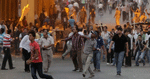
Clashes in Maspero
(Photo: Youm7)
|
Twenty-one human rights organizations (among them the Egyptian Association for Community Participation Enhancement, focal point of Social Watch in that country) accused this week the interim government in Cairo and the Supreme Council of the Armed Forces of inciting the sectarian violence that caused almost 30 deaths this month in Maspero.
|
Published on Fri, 2011-09-02 07:27
Source: The Egyptian Association for Human Rights
Thirty-six Egyptian civil society organizations condemned a "smear campaign" and "attempts to intimidate" carried out by prosecutors who accuse the groups, without identifying them, of "high treason" and of illegally receiving foreign funds. "Those currently administering the country’s affairs after the January 25 revolution are using the same methods of the Mubarak regime," denounced the organizations, among them the Egyptian Association for Community Participation Enhancement (EACPE, focal point of Social Watch in Egypt).
|
Published on Wed, 2011-08-24 08:51
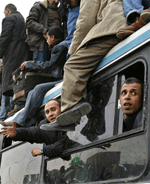
Palestinians stranded at the Rafah
border crossing to Egypt.
(Photo: Asmaa Waguih/IRIN)
|
Sources: Arabic Network for Human Rights Information, UN News Centre.
Eleven Egyptian human rights organizations condemned this week the Israeli attacks against the civil population of Gaza and against Egyptian military personnel in the last days, and demanded that the U.N. Security Council conduct "a fair investigation" with the aim to "bring those responsible to trial". One of the signatory groups is the Egyptian Association for Community Participation Enhancement, focal point of Social Watch.
|
Published on Fri, 2011-08-05 07:39
Source: SIAWI (Secularism is a Women’s Issue)
A coalition of NGOs protested against threats against women’s rights in Egypt, made under the pretext that alleged “human rights” were in fact a throwback from Suzan Mubarak, deposed president Hosni Mubarak’s wife, and that the country should get rid of everything related to the toppled regime.
|
Published on Tue, 2011-07-26 13:42
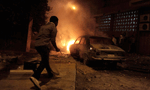
Incidents in Abbasiya.
(Source: Signalfire.org)
|
Source: Report by Salma Shukrallah, Al Ahram
Parties and civil organizations, amongst them Mosharka (national focal point of Social Watch), demand that Egypt's military council and government take responsibility for Abbassiya violence. The groups call for an independent committee to investigate the episode, as they compare it to the infamous 'Battle of the Camel'.
|
Published on Mon, 2011-07-11 08:16
Protests in Cairo. (Photo:
Danish-Egyptian Dialogue
Institute)
|
Source: Al Ahram On Line.
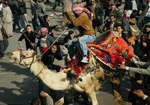
Revolutionary political parties and civil society organizations that have been participating in a sit-in in Tahrir Square since last Friday, including the Egyptian Association for Community Participation Enhancement (EACPE, focal point of Social Watch), issued a statement on Sunday stressing their demands and calling for a million people to march on Tuesday.
|
Published on Thu, 2011-07-07 08:57
Arab Spring at Tahrir Square.
(Photo: Jonathan Rashad/
Creative Commons)
|
Sources: The Guardian, Inter Press Service, ANND's statement.
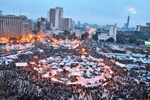
Egypt's government decided not to borrow from the IMF, and the Arab NGO Network for Development (ANND) warned that conditions attached to lending by development banks --as liberalisation of trade, investment and deregulation advocated by the US and the EU-- had contributed to the current unrest in the Arab world, reported the British newspaper The Guardian.
|
Published on Thu, 2011-05-19 13:31
Egypt women after voting. (Photo:
Danish-Egyptian Dialogue Institute)
|
Source: AWID
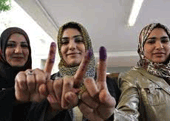
"The gains women achieved over the last decades were not granted, rather the result of the hard work and struggle of women's rights movement and its supporters in Egypt and the Arab region", warned the Network of Women's Rights Organizations in Egypt (NWRO) in a statement launched this month.
|
Published on Wed, 2011-02-23 07:55
If supporting dictatorial regimes like Tunisia and Egypt has been seen as the way to maintain Europe’s security, current events demonstrate the fragility of such strategies, warned three major civil society networks in a letter to Catherine Ashton, High Representative of the European Union for Foreign Affairs and Security Policy. In neglecting the interests of ordinary citizens, this strategy was never sustainable. Sustainability can only be assured by genuine democratic processes, according to the Arab NGO Network for Development (ANND), Eurostep and Social Watch,
Statement to the participants of the international conference on the Southern Mediterranean hosted by the EU High Representative (23 February 2011)
Letter to the EU High Representative (3 February 2011) urging the EU to respond to the popular demands in the region for true inclusive democracy.
|
Published on Thu, 2011-02-10 13:14
Nawara Bilal talks about her experience in al Tahrir square. How social networking started a revolution in Egypt. Testimony presented during the launch of the Social Watch report in Arabic at the World Social Forum, Dakar, 2011.
|
|